
- What WooCommerce Black Friday Hosting Has to Survive
- Your Checkout Ceiling: The One Number Peak Planning Turns On
- The 12-Week WooCommerce Black Friday Hosting Countdown
- How to Rehearse Peak Load Without Taking the Store Down
- When WooCommerce Black Friday Hosting Needs More Than a Shared Plan
- What AHosting Publishes That Makes Peak Planning Possible
- The Change Freeze and the Rollback You Hope Not to Use
- A Practical WooCommerce Black Friday Hosting Checklist
- Frequently Asked Questions About WooCommerce Black Friday Hosting
- How early should WooCommerce Black Friday hosting preparation start in 2026?
- WooCommerce Black Friday hosting vs everyday hosting: what actually changes at peak?
- What is the checkout ceiling, and how do I calculate it for 2026?
- What does AHosting publish that makes WooCommerce Black Friday hosting capacity calculable?
- If my checkout takes 4 seconds, is WooCommerce Black Friday hosting on 40 entry processes enough?
- AHosting WooStart vs a KVM VPS: which suits a store expecting 500 peak orders?
- When does WooCommerce Black Friday hosting need a change freeze, and how long?
- Why does my WooCommerce store slow down only during checkout under heavy traffic?
- Does AHosting guarantee uptime during a 2026 Black Friday traffic spike?
- How do I prepare my WooCommerce store for Black Friday traffic?
WooCommerce Black Friday hosting is decided by one number: entry processes divided by checkout execution time. Measure it in September, rehearse it in October, freeze the site in November.
Most advice about WooCommerce Black Friday hosting arrives as the same four bullets: upgrade the plan, add a content delivery network, turn on caching, take a backup. None of it is wrong. All of it is unfalsifiable, because none of it produces a number you can check your store against.
There is such a number, and your host either publishes the inputs or it does not. This post derives it, shows what makes it collapse under load, and hangs a dated twelve-week schedule off it, with an explicit go or no-go gate at the end of each stage. Black Friday 2026 falls on November 27, so the clock starts the first week of September.
What WooCommerce Black Friday Hosting Has to Survive
Peak season does not raise the amount of work your server can do. It changes the kind of work it is asked to do, and the change runs in the wrong direction. Understanding that inversion is most of what WooCommerce Black Friday hosting planning consists of.
The Checkout Is the One Page That Cannot Be Cached
On an ordinary day, a well configured store serves nearly everything from cache. Product pages, category listings and the home page are rendered once and handed to every later visitor as static HTML, which is why a shared container can absorb traffic that looks alarming in an analytics chart. Cached pages consume zero entry processes.
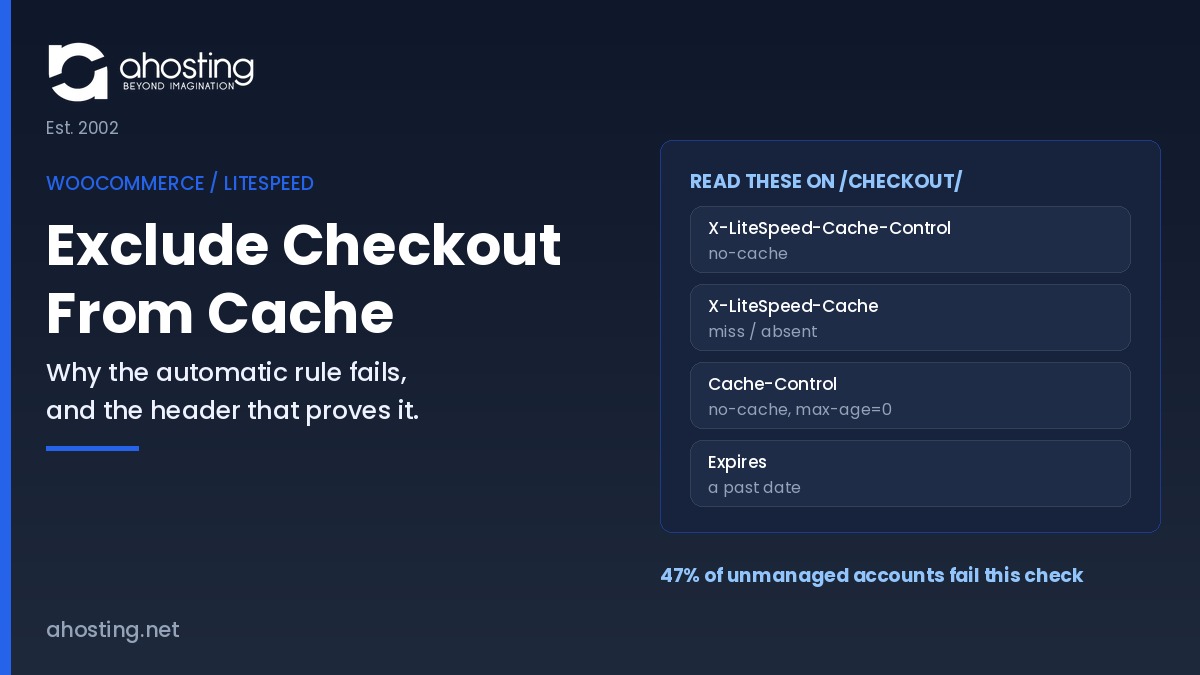
Cart, checkout and account pages are different by necessity. Each visitor sees different contents, so each request has to execute PHP and query the database. Every serious caching layer excludes them deliberately, and the LiteSpeed Cache exclusion settings are where that exclusion is configured and confirmed. Getting the exclusion wrong in either direction is expensive: cache the checkout and customers see each other’s carts, leave a heavy page uncached and you burn slots for nothing. The verification method is in our guide to excluding checkout from cache correctly.
Consequently, a sale inverts the traffic mix. The share of requests that reach PHP climbs from a few percent to a large fraction, and the slowest pages in the store are the ones absorbing it.
Why Peak Concurrency Beats Monthly Visits as the Planning Unit
Monthly visits describe a year of browsing. They tell you nothing about the ninety seconds after an email lands in 40,000 inboxes, which is the only window that decides whether a sale goes well.
The unit that matters is concurrency: how many requests are being processed at the same instant. A container permits a fixed number of simultaneous PHP processes, and when they are all busy the next request waits in a queue rather than failing outright. Queued requests are what customers experience as a store that has gone slow, and beyond a certain queue depth they are what the server reports as a resource limit. We covered the underlying arithmetic for page traffic in our analysis of how many concurrent users shared hosting handles.
Checkout raises the stakes because each unit of work is slower and worth more. A queued product page costs you patience; a queued payment step costs you the order.

Your Checkout Ceiling: The One Number Peak Planning Turns On
Everything above reduces to a single quantity. Given a fixed number of concurrent PHP slots and a known time per checkout request, the throughput your store can sustain is fully determined. Nothing about sizing WooCommerce Black Friday hosting is proprietary or mysterious once those two inputs exist.
The Checkout Ceiling Formula
Divide the number of entry processes by the checkout execution time in seconds, and you have checkout requests per second. Multiply by sixty for the per-minute figure. The relationship is a direct application of the 1961 queuing result known as Little’s Law, which states that the average number of items in a system equals the arrival rate multiplied by the time each one spends there. Rearranged for a system with a hard concurrency cap, it gives you the maximum arrival rate the cap will sustain.
Two adjustments make the result honest. One checkout does not equal one request: a real order costs roughly half a dozen uncacheable calls between adding to cart, applying a coupon, refreshing totals, placing the order and returning from the payment gateway. And checkout is not the only thing competing for slots, since administrative sessions, scheduled jobs and crawlers draw from the same pool. Assume you get half of the theoretical figure and you will not be disappointed.
The WooCommerce Checkout Ceiling Table
Below is the arithmetic worked through at 40 entry processes, which is the figure the AHosting WooStart plan publishes. Read it as a model rather than as a measurement: it assumes six uncacheable requests per order and slots that are otherwise idle. Other plan tiers scale the first column linearly.
| Checkout execution time | Checkout requests per minute | Orders per minute at 6 requests each | What usually puts a store on this row |
|---|---|---|---|
| 1 second | 2,400 | 400 | Persistent object cache, lean checkout, healthy database |
| 2 seconds | 1,200 | 200 | A typical store that has never been profiled |
| 4 seconds | 600 | 100 | Cart fragments on every page, no object cache |
| 8 seconds | 300 | 50 | Database lock contention once concurrency rises |
| 16 seconds | 150 | 25 | Scheduled job backlog plus payment gateway retries |
The striking part of that table is not the top row. It is how far a store falls when execution time inflates, and inflation is exactly what heavy concurrency causes. A store measured at two seconds in October is not a store running at two seconds during the sale.
How to Measure Your Store’s Real Checkout Execution Time
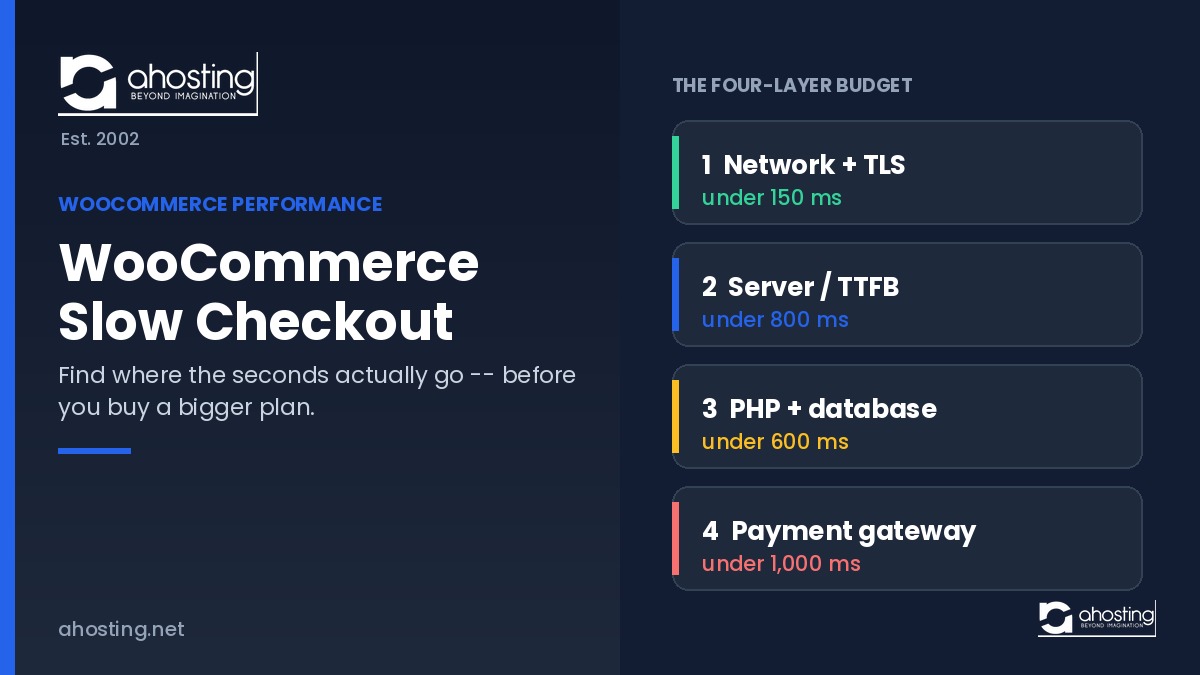
Measure server time, not page load time. The two are routinely confused, and only one of them consumes an entry process. What you want is the time the server spends generating the checkout response, which you can read from a server timing header or from a query monitoring plugin on a staging copy.
Additionally, measure it three times: once on a quiet morning, once with a coupon applied, and once with a full cart and a shipping calculation. Those three numbers are usually not close to each other, and the worst of them is the one to plan against. Interaction responsiveness on the front end matters separately, and the Interaction to Next Paint metric is the current measure for it, but it is a different problem from server capacity. Where the seconds actually accumulate is the subject of our walkthrough on finding where checkout time is spent.
The 12-Week WooCommerce Black Friday Hosting Countdown
Each stage below ends in a gate. Passing the gate is what earns the right to move to the next stage; failing it means the schedule slips rather than the standard. Dates are for Black Friday on November 27, 2026.
| Stage | Dates in 2026 | Work | Go or no-go gate |
|---|---|---|---|
| Weeks 12 to 9 | September 7 to October 2 | Measure the checkout ceiling; fix the slow paths | Checkout execution time is known and has improved measurably |
| Weeks 8 to 5 | October 5 to October 30 | Rehearse peak load against a staging copy | A rehearsal at twice expected peak completes with no errors |
| Weeks 4 to 2 | November 2 to November 13 | Size the plan and migrate if the rehearsal demanded it | The final infrastructure has itself been rehearsed |
| Week 1 | November 16 to November 27 | Change freeze, monitoring, rollback drill | A tested restore exists and someone is rostered to watch |
Weeks 12 to 9: Measure, Then Fix the Slow Paths
Begin with measurement, because every later decision is scaled by the checkout execution time. Only then start removing work from the request. The reliable wins are consistent across stores: a persistent object cache, database tables that have been cleaned of expired transients, and any plugin that runs on every page rather than only where it is needed.
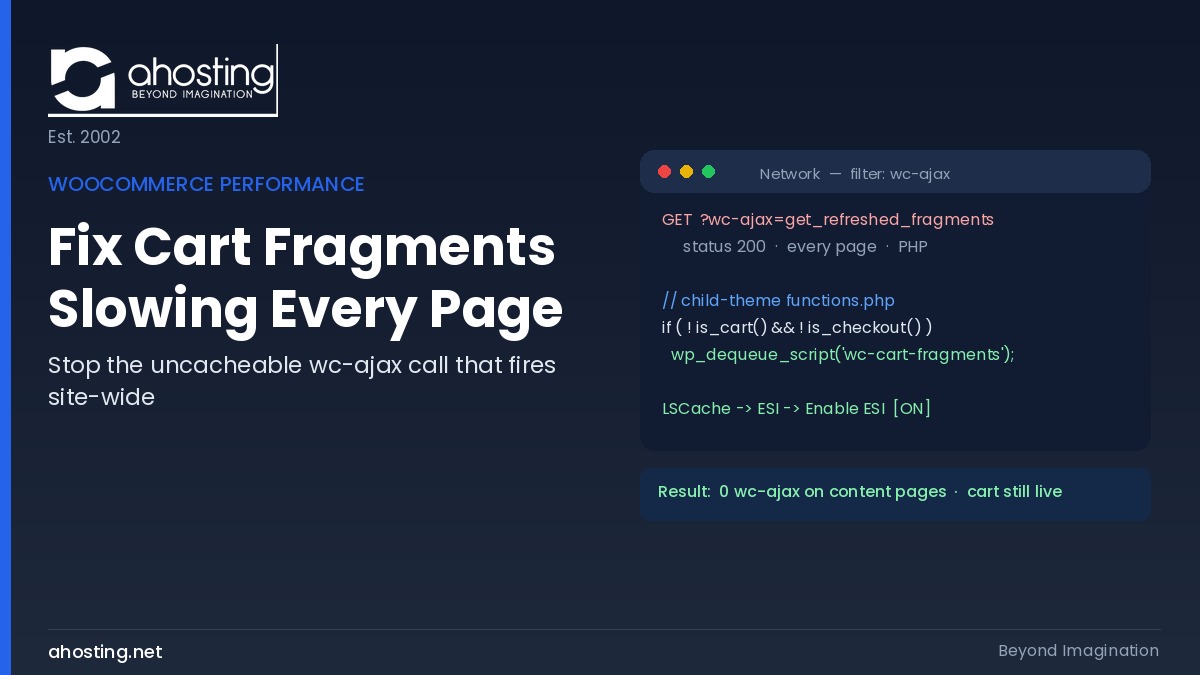
The single most common offender in a WooCommerce store is the cart fragments request, which fires on every page view whether or not the visitor has a cart. Our post on stopping cart fragments from slowing every page covers the fix. Beyond that, the WooCommerce performance best practices are the canonical checklist for what belongs on a request path and what does not.
By the end of this stage you should be able to state your checkout execution time as a number and show that it moved.
Weeks 8 to 5: Rehearse the Peak
A fix that has not been tested under load is a hypothesis. This stage converts hypotheses into evidence by generating traffic that resembles a real sale against a staging copy of the store.
Rehearse twice. The first run establishes that the machinery works and usually finds something broken in the test itself. The second run is the one that counts, and it should be aimed at twice the peak you actually expect. Twice is not pessimism; it is the margin that absorbs the execution time inflation the ceiling table describes.
Weeks 4 to 2: Size the Plan and Move Early
If the rehearsal says the current tier cannot carry the peak, this is the window in which to move. Migrating in the final fortnight is the classic unforced error, because a migration changes the thing you spent eight weeks measuring and leaves no time to measure it again.
Moreover, the destination should be chosen for the capability it adds rather than for the size of its specification sheet. A store that needs a persistent object cache, a tuned database server, or a background worker that outlives a single request is describing a virtual private server with allocated resources rather than a larger shared container. Whichever tier you land on, rehearse again on the new infrastructure before the gate closes.
Week 1: The Change Freeze
Nothing ships in the final week. No plugin updates, no theme edits, no PHP version changes, no new payment methods, no clever last-minute banner. The freeze feels excessive right up until the moment it saves a sale.
Use the week for the things that carry no risk: confirm the restore actually restores, check that alert thresholds are set low enough to be useful, and put a named person on watch for the first hour of the sale. A monitoring dashboard nobody is looking at is decoration.
How to Rehearse Peak Load Without Taking the Store Down
A rehearsal is only useful if it resembles the event. Most WooCommerce Black Friday hosting load tests fail that standard by hammering the home page, which is cached and therefore free, and concluding that the store is bulletproof.
Building a Checkout Load Test That Resembles Real Buyers
Model the journey rather than a URL. A realistic script browses two or three products, adds one to the cart, applies a coupon, reaches checkout and places an order, with pauses between steps that resemble a person reading. Cookies must persist across the journey, or every request looks like a new visitor and the cart never fills.
Run it against staging, never production, and against a database that has been seeded with a realistic catalog and order history. An empty database returns query times that no live store will ever see. Guidance on ramp profiles and how to escalate load is in the k6 stress testing guide, which describes the shape of a run rather than a specific tool.
The Four Signals to Watch During a WooCommerce Black Friday Hosting Rehearsal
First, checkout execution time as concurrency rises. A flat line means headroom. A curve that bends upward tells you where the ceiling actually sits, and that inflection is the single most valuable output of the whole exercise.
Second, the background job queue. WooCommerce defers a great deal of work to scheduled actions, and when they fall behind the symptom is orders that appear stuck rather than a page that is slow. The Action Scheduler throughput notes explain how the queue drains and what limits it.
Third, database wait time, which is where contention shows up first. Fourth, payment gateway responses under concurrency, because a gateway that times out produces duplicate charges or orphaned orders depending on how your store handles the failure. The Stripe error handling documentation is a good model for the failure modes any gateway integration has to survive.
When WooCommerce Black Friday Hosting Needs More Than a Shared Plan
Shared hosting carries far more peak traffic than its reputation suggests, provided the caching is right and the checkout is lean. The honest trigger for moving to a larger tier of WooCommerce Black Friday hosting is a capability the container cannot provide, not a number of visitors.
It is worth noting what plan pages typically disclose. Our own shared hosting tiers publish site counts and storage, as nearly every plan page does. The concurrency figures that decide peak behavior are published on the WooCommerce plan specifically, which is the exception rather than the rule across this industry.
Shared, WooStart, VPS, Dedicated: A Peak-Load Comparison
| Tier | Published limits | What it changes at peak | Choose it when |
|---|---|---|---|
| Shared tiers | 5 to 20 sites, 15 to 60 GB SSD; concurrency not published | Nothing on its own; caching does the work | The store is small and the checkout is already lean |
| WooStart | 40 entry processes, 3 GB memory, up to 3 CPU cores, 20 MB/s and 2,048 IOPS | Gives you a ceiling you can calculate | You want the numbers before you plan |
| KVM VPS | 2 to 16 vCPU, 4 to 32 GB RAM, 50 to 150 GB SSD | Allocated resources, root, persistent services | A capability is blocked, not merely tight |
| Dedicated server | Whole machine, single tenant | Removes every neighbor from the equation | One store justifies the entire machine |
Ultimately, the jump to a single-tenant dedicated machine is a decision about isolation rather than about raw capacity. Most stores that think they need one need a persistent object cache and a fixed checkout instead.
What AHosting Publishes That Makes Peak Planning Possible
AHosting has run hosting infrastructure from Southfield, Michigan since 2002, and the platform carries a published 99.9% uptime commitment. Availability, though, is not the interesting number for a store owner planning a sale, because a fully available server can still take sixteen seconds to take a payment.
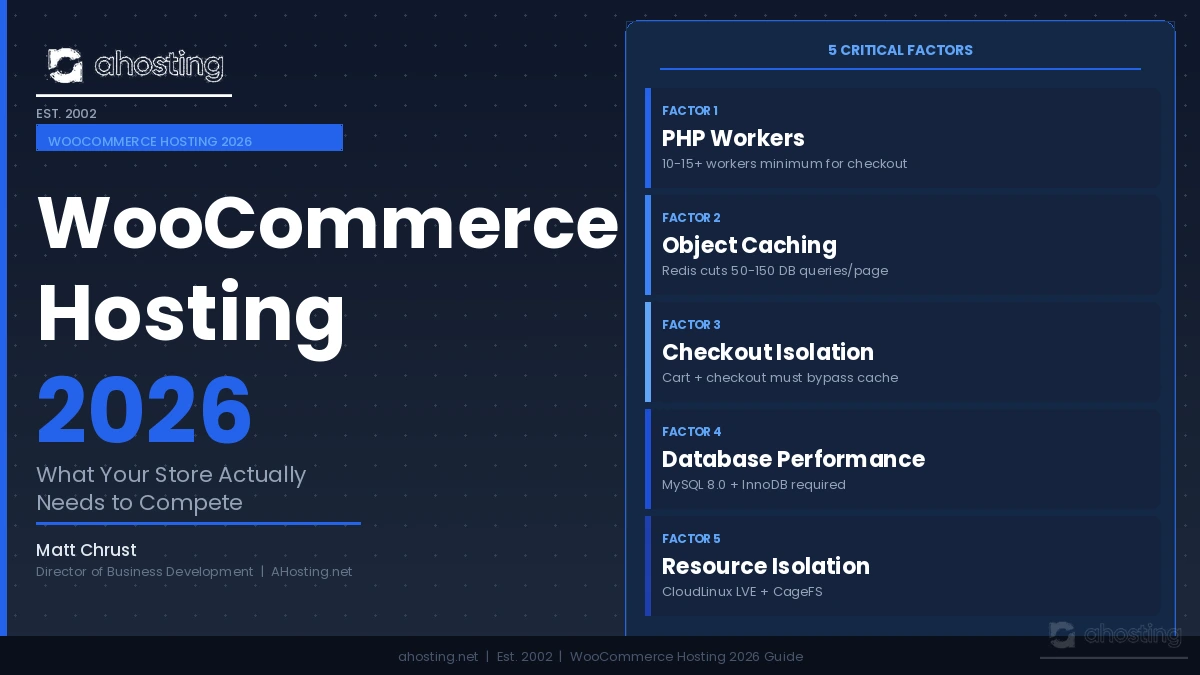
The figures that matter are the concurrency limits, and the WooStart plan prints them: 40 entry processes, 3 GB of physical memory, up to 3 CPU cores, 20 MB/s of disk throughput and 2,048 IOPS. Those five numbers are the entire input to the ceiling calculation. A plan page that prints only storage and the word unlimited leaves you unable to compute anything at all, which is convenient for whoever wrote the page.
Check Your WooCommerce Black Friday Hosting Readiness
Rather than reading the ceiling table across, put your own two numbers into the check below. It assumes the published 40 entry processes and six uncacheable requests per order.
Check Your WooCommerce Black Friday Hosting Readiness
Two numbers: how long your checkout takes on the server, and how many orders you expect in the busiest hour.
The Change Freeze and the Rollback You Hope Not to Use
A rollback plan that has never been executed is a wish. The last stage of WooCommerce Black Friday hosting preparation exists to convert it into a procedure somebody has actually performed, on this store, with this data.
Restore a backup to a staging site and open the store. Place a test order. Confirm the order number, the payment record and the stock count all agree. That exercise routinely uncovers a backup that excludes the uploads directory or a database dump that predates a schema change, and finding it in November is considerably better than finding it during the sale.
Similarly, agree in advance what triggers a rollback and who decides. A threshold written down while everyone is calm is worth more than a judgment call made at two in the morning with orders queuing. Write down the checkout execution time at which you intervene, the error rate at which you disable a nonessential plugin, and the person whose call it is.
A Practical WooCommerce Black Friday Hosting Checklist
Work through the ten items below in order. Together they are what WooCommerce Black Friday hosting preparation amounts to in practice, and each one is cheap to do in September and expensive to improvise in November.
- Measure checkout execution time on the server three ways: quiet, with a coupon, and with shipping calculated.
- Confirm cart, checkout and account pages are excluded from page cache, and that nothing else is.
- Remove the cart fragments request from pages that do not need it.
- Add a persistent object cache and confirm it is actually being hit.
- Clear expired transients and check for database tables that have never been cleaned.
- Compute your checkout ceiling from your plan's entry process figure, then halve it.
- Rehearse the full buying journey on staging at twice your expected peak.
- Migrate, if the rehearsal demands it, no later than two weeks out, then rehearse again.
- Freeze all changes one week out and restore a backup to staging to prove it works.
- Set alert thresholds, and roster a named person to watch the first hour of the sale.
Notably, only two of those items involve buying anything. The rest are measurement and discipline, which is the honest summary of peak readiness: capacity planning is mostly the removal of avoidable work, and the plan tier is what carries whatever remains.
Frequently Asked Questions About WooCommerce Black Friday Hosting
How early should WooCommerce Black Friday hosting preparation start in 2026?
Specifically, twelve weeks out. Black Friday falls on November 27 in 2026, which puts the first measurement week in early September. That spacing exists for one reason: every fix worth making needs a rehearsal after it, and a rehearsal needs a quiet week to run in. The countdown table in this post sets a go or no-go gate at the end of each stage.
WooCommerce Black Friday hosting vs everyday hosting: what actually changes at peak?
Notably, the resources do not change at all; the mix of requests does. On an ordinary day most traffic is cached pages that cost nothing, so entry processes sit idle. During a sale the ratio inverts, cart and checkout requests dominate, and every one of them has to execute PHP. The plan you were happy with on Tuesday is being asked to do a different job.
What is the checkout ceiling, and how do I calculate it for 2026?
In practice, the checkout ceiling is the number of checkout requests your container can have in flight at once divided by how long each one takes. Forty entry processes against a two-second checkout gives 1,200 requests per minute. The arithmetic is Little's Law, and the number that matters is the one your store hits under load, not the one it measures on a quiet morning.
What does AHosting publish that makes WooCommerce Black Friday hosting capacity calculable?
Indeed, this is unusual enough to be worth stating plainly. The WooStart plan page prints 40 entry processes, 3 GB physical memory, up to 3 CPU cores, 20 MB/s disk I/O and 2,048 IOPS. Most plan pages print storage and the word unlimited. Without the entry process figure there is no ceiling to compute.
If my checkout takes 4 seconds, is WooCommerce Black Friday hosting on 40 entry processes enough?
Typically, yes, and that surprises people. Forty slots against a four-second checkout still clears 600 requests a minute, which is roughly 100 orders a minute at six uncacheable requests each. The danger is not the starting number. It is that four seconds becomes twelve under database contention, and the ceiling falls by the same factor.
AHosting WooStart vs a KVM VPS: which suits a store expecting 500 peak orders?
Ultimately, 500 orders across a peak hour is comfortably inside what 40 entry processes will carry, so the shared container is not the deciding factor. A KVM instance earns its price when you need a persistent object cache, a tuned database server, or a background worker that outlives a request. Buy the VPS for the capability, not for the order count.
When does WooCommerce Black Friday hosting need a change freeze, and how long?
As such, the freeze starts one week out and runs through the sale. Nothing ships after that date: no plugin updates, no theme edits, no PHP version change, no new payment method. A freeze is not caution for its own sake. It is what makes a rollback meaningful, because you can only revert to a state you have actually tested.
Why does my WooCommerce store slow down only during checkout under heavy traffic?
Furthermore, that pattern is diagnostic rather than mysterious. Catalog and category pages are served from cache and never reach PHP, so they stay fast no matter how many people arrive. Cart and checkout are excluded from cache by design, so they absorb the entire load, and they are also the slowest pages your store runs.
Does AHosting guarantee uptime during a 2026 Black Friday traffic spike?
Accordingly, the published commitment is a 99.9% uptime SLA, and it applies during a sale exactly as it does on any other day. That figure covers availability of the platform, not the speed of your own checkout code. A store can be fully available and still lose orders to a sixteen-second payment step.
How do I prepare my WooCommerce store for Black Friday traffic?
First and foremost, measure your checkout execution time before changing anything, because every later decision is scaled by that one number. Then fix the slow paths, rehearse the peak against a real load profile, size the plan while moving is still cheap, and freeze the site a week out. The countdown table sets the dates.