
- Listen to podcast!
- Introduction: The Old Debate Is Dead. AI Killed It.
- What AI Search Engines Actually Do (And Why It Matters for Your Host)
- The IP Reputation Problem in the AI Era
- The "Bad Neighbor" Effect on AI Visibility — A Concrete Example
- WordPress + Dedicated IP: The AI-Ready Foundation
- What Else Your WordPress Site Needs for AI Visibility
- The AHosting Advantage: 20+ Years of Infrastructure Experience
- A Practical Checklist: Is Your Hosting AI-Search Ready?
- Conclusion: The New Rules of Being Found
- FAQ
Listen to podcast!
Introduction: The Old Debate Is Dead. AI Killed It.
Let me guess. You’ve heard it a hundred times: “A dedicated IP address doesn’t help your SEO.”
And honestly? For traditional Google rankings, that’s mostly true. Google’s own John Mueller confirmed it years ago. Thousands of Fortune 500 companies run on shared IPs without losing a single ranking position. The dedicated IP vs. shared IP SEO debate has been closed for a decade.
So why am I bringing it up in 2026?
Because the game just changed again — and this time, the stakes are higher.
In 2026, your website’s visibility is no longer decided solely by Google’s ranking algorithm. It’s decided by AI search engines: ChatGPT, Perplexity, Google AI Overviews, Gemini, and Copilot. These systems don’t work like traditional search. They don’t just rank pages. They choose sources to trust, crawl, and cite — and they do it based on signals that look very different from the old SEO playbook.
One of those signals? Your hosting infrastructure. And yes — that includes your IP address.
I’ve spent over 20 years in hosting infrastructure, and I’ll tell you plainly: the way AI bots evaluate your site’s trustworthiness is not the same as how Googlebot does. The implications for WordPress site owners are real, they’re happening now, and most people aren’t talking about them yet.
Let’s fix that.
What AI Search Engines Actually Do (And Why It Matters for Your Host)
Before we get into IP addresses specifically, you need to understand how AI search actually works under the hood.
When someone asks ChatGPT “What’s the best WordPress hosting with a dedicated IP?”, the model doesn’t just recall information from training data. It uses a process called Retrieval-Augmented Generation (RAG) — it crawls the web in real time, selects sources it considers trustworthy and relevant, extracts structured information, and synthesizes a response. Your site either gets cited or it doesn’t.
The factors that influence whether an AI engine picks your content as a citation source include:
- Uptime reliability — AI bots crawl frequently. If your server is down or slow, they move on.
- Page load speed — AI crawlers have time constraints. A slow TTFB (Time to First Byte) directly reduces crawl frequency.
- Content structure — Schema markup, FAQ sections, clear headings, and direct answers make content easy to parse and cite.
- IP reputation — This is where it gets interesting.
- Entity clarity — Is it obvious who you are, what you do, and why you should be trusted?
Notice that hosting infrastructure occupies several spots on that list. Your host isn’t just a place your files live — it’s a trust signal delivery system for the AI era.
The IP Reputation Problem in the AI Era
Here’s the thing about shared hosting that the “IP doesn’t matter” crowd glosses over in 2026.
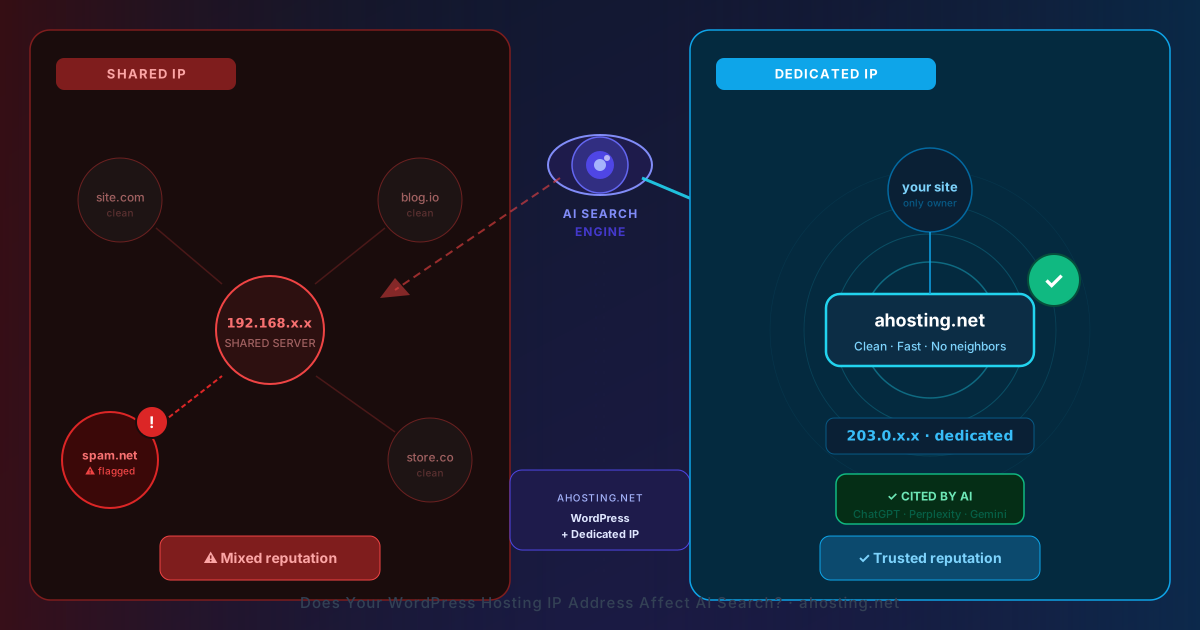
When you’re on a shared IP, you share your digital address with dozens — sometimes hundreds — of other websites. On a quality host, those neighbors are mostly fine. But on a low-quality shared server, even one problematic neighbor can affect how external systems perceive your IP.
Traditional Google search handles this well. Google evaluates sites individually and is sophisticated enough to isolate bad actors from their good neighbors. This is well-established, and it’s why shared IPs don’t hurt rankings on reputable hosts.
But AI crawlers are different.
AI platforms like Perplexity use their own web crawlers (PerplexityBot). ChatGPT’s browsing capability uses SerpAPI and direct crawling. Google’s AI Overviews pull from their own index, weighted by freshness and trust signals. And here’s the key insight:
AI systems are building their own trust models — and those models are less forgiving of IP-level reputation signals than traditional search indexing.
If your IP has been associated with spam, poor deliverability, or inconsistent uptime patterns, AI bots may deprioritize crawling it. This doesn’t mean they blacklist your site — it means they crawl it less frequently, trust it less implicitly, and are less likely to surface it as a citation source when alternatives are available.
With a dedicated IP, you control your own reputation entirely. There are no neighbors. Your IP’s history is your history. And when AI bots see a clean, stable, consistently-available IP that always responds fast, they assign it more crawl priority — which translates directly into more citation opportunities.
The “Bad Neighbor” Effect on AI Visibility — A Concrete Example
Let me make this tangible.
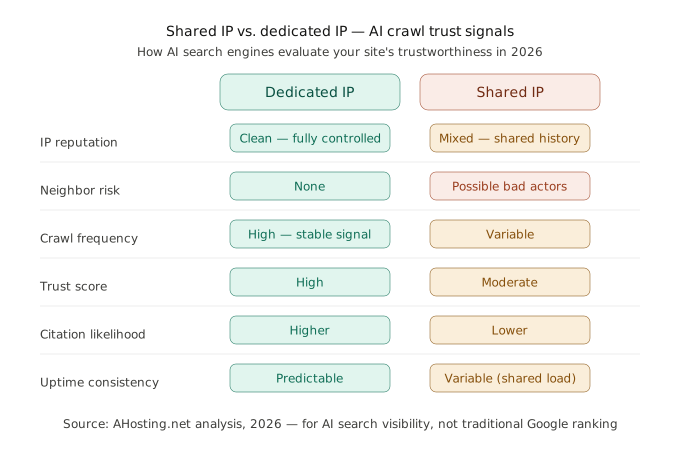
Imagine two WordPress sites. Both publish great content. Have proper schema markup. Both update their content regularly. The only difference: Site A is on a shared IP with 80 other sites, three of which have been flagged for spam email behavior. Site B is on a dedicated IP — clean, isolated, with a consistent uptime history.
An AI crawler visits both sites on the same day. Here’s what happens:
| Factor | Site A (Shared IP) | Site B (Dedicated IP) |
|---|---|---|
| Crawl frequency | Moderate | High |
| IP reputation check | Mixed signals | Clean |
| Response time consistency | Variable (shared resources) | Consistent |
| Trust score for citation | Moderate | High |
| Likelihood of AI citation | Lower | Higher |
Neither site did anything wrong. But Site B — because of its hosting environment — gets treated as a more reliable source. Over time, this compounds. More citations mean more brand mentions across the web, which feed back into AI training data, which increases future citation probability.
This is what we call the AI citation compounding effect. It’s not about one crawl. It’s about building a sustained, high-trust presence in the AI knowledge graph.
WordPress + Dedicated IP: The AI-Ready Foundation
Here’s where AHosting’s WordPress hosting becomes directly relevant to this conversation.
Most WordPress hosting providers offer dedicated IPs as a paid add-on — typically $2–5/month extra, sometimes more. At AHosting, every WordPress plan (Bronze, Silver, and Gold) includes a free dedicated IP as a standard feature. Not an upsell. Not a premium tier. Standard.
Why do we do this? Because we’ve been in hosting infrastructure for over 20 years, and we saw this shift coming. A dedicated IP isn’t just a technical checkbox — it’s a foundational investment in your site’s long-term credibility with every system that evaluates it, including AI search engines.
Pair that with what else comes standard on AHosting WordPress plans:
- Free SSL certificate — Essential for HTTPS, which AI bots require for trust
- 99.9% uptime guarantee — Consistent availability = consistent AI crawlability
- cPanel with one-click WordPress install — Get live fast, stay optimized
- Daily and weekly backups — Protect your content asset
- 24/7 human support — Real experts, not bots, when things go wrong
- US and EU data centers — Low latency for your audience, wherever they are
For a WordPress site targeting AI search visibility in 2026, this stack is purpose-built.
What Else Your WordPress Site Needs for AI Visibility
The dedicated IP is your foundation. But AI-ready hosting is a complete system. Here’s what you need on top of it:
1. An llms.txt File
Just like robots.txt tells search engines what to crawl, llms.txt is an emerging standard that tells AI models what your site is about and which content matters most. Place it at yourdomain.com/llms.txt. WordPress plugins like LLMagnet can auto-generate this for you.
2. Schema Markup (JSON-LD)
AI systems love structured data. At minimum, implement:
Articleschema on blog posts (withauthor,datePublished,dateModified)FAQPageschema on any FAQ sectionsOrganizationschema on your homepageHowToschema on instructional content
3. Direct Answer Formatting
Every section of your content should open with a clear, direct answer to the question it addresses. AI engines extract these for generated responses. If your content buries the answer in paragraph 6, you lose the citation to someone who put it in sentence 1.
4. Content Freshness
AI models weight recently updated content more heavily. Add a visible “Last Updated: [date]” to every post. Update high-value pages every 4–6 weeks — not cosmetically, but with genuinely new information or data.
5. Strong Internal Linking
Build topical clusters. Link your blog posts to your product pages, and link related posts to each other. AI systems use link graphs to evaluate entity relationships and authority. A well-linked site signals a coherent, authoritative presence.
Use the tool below to score your current hosting setup for AI search visibility.
The AHosting Advantage: 20+ Years of Infrastructure Experience
There’s a reason we’ve been trusted since 2002. Hosting trends come and go — dial-up, broadband, mobile, cloud, and now AI. Every time the landscape shifts, the fundamentals stay the same: reliability, speed, and clean infrastructure.
The AI search era is just the latest expression of principles we’ve always believed in. A clean dedicated IP isn’t new to us — it’s always been how we think hosting should work.
“Keep your SEO safe — dedicated IPs prevent your site from being dragged down by bad neighbors.” — AHosting product page
In 2026, that same philosophy applies to AI search visibility. And now, it applies to whether ChatGPT cites you or your competitor.
Explore our WordPress hosting plans — all with free dedicated IP included — and our web hosting options for non-WordPress projects. If you’re running multiple sites, our reseller hosting gives every client their own clean environment.
A Practical Checklist: Is Your Hosting AI-Search Ready?
Run through this before you publish your next piece of content:
Hosting Infrastructure
- Dedicated IP (free with all AHosting WordPress plans)
- 99.9%+ uptime guarantee
- Sub-200ms TTFB (Time to First Byte)
- SSL/HTTPS enabled
- US or EU data center with CDN support
Technical On-Page
- llms.txt file at domain root
- Article schema with dateModified
- FAQPage schema on FAQ sections
- Organization schema on homepage
- robots.txt allows major AI bots (GPTBot, PerplexityBot, ClaudeBot)
Content Structure
- Direct answer in first 2 sentences of each section
- Clear H1/H2/H3 hierarchy
- FAQ section with 5+ Q&As per post
- “Last Updated” date visible on page
- Internal links to related content and product pages
Brand Entity Signals
- Consistent author attribution (name + credentials)
- Company name, location, and founding date clearly on site
- Active profiles on platforms AI models index (LinkedIn, G2, Trustpilot)
Conclusion: The New Rules of Being Found
The SEO debate about dedicated IPs was settled years ago — and everyone on the “it doesn’t matter” side was right, for the old game.
The new game is different. AI search engines are now the primary discovery channel for a growing percentage of internet users. They use different signals, different crawl patterns, and different trust models. And your hosting infrastructure — IP reputation, uptime, response time, data center quality — is part of how they decide whether to trust you.
AHosting has been building reliable, fast, clean-infrastructure hosting since 2002. The free dedicated IP that comes with every WordPress plan isn’t a gimmick — it’s a reflection of how we’ve always believed hosting should work.
In 2026, that belief has a new beneficiary: your AI search visibility.