
- What the 2026 Web Hosting Industry Trends Have in Common
- AI on Both Sides: Web Hosting Industry Trends Factor 1
- Edge and Serverless: Web Hosting Industry Trends Factor 2
- Power and Cooling: Web Hosting Industry Trends Factor 3
- Managed Services: Web Hosting Industry Trends Factor 4
- Consolidation and Spec Transparency: Web Hosting Industry Trends Factor 5
- Which Web Hosting Industry Trends Change Your Plan Choice
- Auditing Your Plan Against 2026 Web Hosting Industry Trends
- Frequently Asked Questions About Web Hosting Industry Trends
- Which web hosting industry trends actually affect a small business site in 2026?
- Edge hosting vs shared hosting: which web hosting industry trends favor each model?
- How does AHosting measure AI crawler share against web hosting industry trends data?
- When should a WordPress site on 15 entry processes worry about AI crawler load?
- Are hosting platforms moving away from cPanel as web hosting industry trends shift in 2026?
- Serverless vs traditional hosting: what do cold starts cost a typical small business site?
- How much of United States electricity did data centers consume, and where is it heading?
- If AHosting caches a page with LSCache, does an AI crawler request still consume a PHP worker?
- Will web hosting industry trends push hosting prices up in 2026 and beyond?
- What do web hosting industry trends mean for AHosting plan specifications?
The web hosting industry trends that change your plan choice in 2026 are AI crawler load, power-constrained capacity, and control-plane consolidation. Edge and serverless change less than the coverage suggests.
Ask what is changing in hosting right now and you get a list of technologies. That is the wrong list. The web hosting industry trends that matter in 2026 are not the ones with the most conference talks behind them, they are the ones that change a number on your invoice or a ceiling on your account. Two of the five below do that. Three do not, and saying so plainly is more useful than another survey of the field.
This post separates the two groups using AHosting production measurements and published federal energy data, not vendor positioning. If you are still choosing a provider rather than auditing one, the companion guide on choosing a web hosting provider for a small business covers the decision itself.
What the 2026 Web Hosting Industry Trends Have in Common
Every trend on this list is a change in where work happens. Notably, that is the only axis that reliably predicts whether a trend will reach your account. AI-assisted building moves work from a developer to a model. Crawler growth moves work from humans to bots. Power scarcity moves work from anywhere to wherever electricity is available. Consolidation moves work from many vendors to few.
Consequently, the useful question is never “is this real.” It is “does this move work onto or off of the server I am renting.” Trends that move work onto your origin cost you capacity. Trends that move it elsewhere cost you money or control. Anything that does neither is industry news, and belongs in a newsletter rather than a purchasing decision. Ordinary shared hosting buyers can safely ignore most of the second category.

AI on Both Sides: Web Hosting Industry Trends Factor 1
Artificial intelligence is reshaping hosting from two directions at once, and the industry talks about only one of them. Specifically, the demand side gets the coverage while the supply side quietly consumes server capacity.
The Demand Side: AI-Assisted Building Changes Who Buys Hosting
Furthermore, AI site builders have compressed the gap between having an idea and having a deployed site. The practical consequence for hosting is not that fewer people need servers, it is that more first-time owners arrive with a working site and no operational vocabulary. They have never read an error log. They do not know what a PHP worker is.
In practice, that shifts what a hosting plan must supply. Generated sites tend to carry heavier plugin stacks and less efficient queries than hand-built ones, because nothing in the generation step optimizes for server cost. Accordingly, the resource profile of a typical new WordPress hosting account in 2026 skews toward more PHP execution per visitor than the same account five years ago.
The Supply Side: Crawlers Are Now a Measured Share of Server Load
The half nobody covers is what AI does to your origin. Retrieval crawlers fetch pages continuously to keep answer engines current, and they do not browse the way people do. Moreover, they do not stop at the pages you promoted. They walk archives, tags, paginated listings, and query-string variants that no human has requested in years.
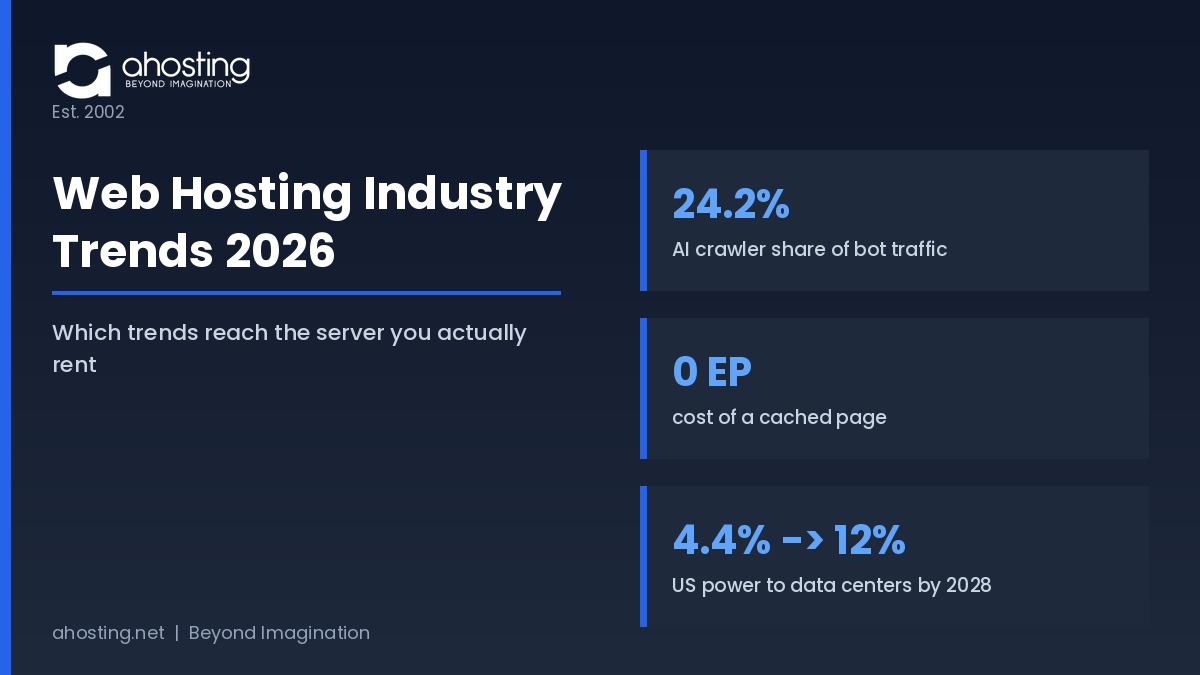
Measured across the AHosting production fleet in August 2026, AI retrieval crawlers account for 24.2 percent of all bot traffic. That is a share of bot traffic specifically, not of total requests. Even so, it is a quarter of automated load attributable to a request class that did not meaningfully exist three years ago, and it arrives on the same entry processes your visitors use. The related question of whether those crawlers can reach and read your content is covered separately in the guide to optimizing WordPress for AI search.
Additionally, the governance layer is finally forming. The IETF AI Preferences working group is standardizing a machine-readable vocabulary for expressing how content may be used by AI systems, attachable through robots.txt or an HTTP response header, and its published charter puts crawler authentication explicitly out of scope. Therefore robots.txt remains an access control, not a load control, and load is a hosting problem.
The AHosting AI Crawler Load Ledger
In other words, the useful translation is from share of traffic to share of ceiling. The ledger below does exactly that. Every row is either measured on the AHosting fleet or published in AHosting plan specifications, so the arithmetic can be reproduced rather than trusted.
| Measure | Value | Source | What it means for crawler load |
|---|---|---|---|
| AI retrieval crawlers, share of all bot traffic | 24.2% | Measured, AHosting fleet, Aug 2026 | Baseline for every row below |
| Cache hit, any requester | 0 entry processes | LiteSpeed serves before PHP starts | Crawler volume is free while cached |
| Cache miss, any requester | 1 entry process, held for full request duration | LVE accounting | This is the only row that costs capacity |
| Bronze ceiling | 15 entry processes / 512 MB container memory | Published plan spec | Smallest crawler headroom |
| Silver ceiling | 25 entry processes / 1024 MB | Published plan spec | Typical crawler-safe floor for large archives |
| Gold ceiling | 40 entry processes / 2048 MB | Published plan spec | Headroom for faceted or query-string URL sprawl |
| Queue behavior at ceiling | Requests queue up to 120 seconds, then 503 | LiteSpeed connTimeout | Crawlers retry, compounding the queue |
Read the ledger from the bottom up and the operational conclusion inverts the usual advice. Blocking crawlers is the loud answer; cache coverage is the effective one. A cached page costs nothing no matter how many bots request it, so the site that suffers under crawler load is almost always the site whose cache is being missed, not the site receiving the most bots.
Edge and Serverless: Web Hosting Industry Trends Factor 2
Both technologies are genuine engineering achievements. However, both are routinely recommended to sites that cannot benefit from them, and the honest assessment is less flattering than the marketing.
What Edge Actually Moves, and What It Cannot
Edge networks place cached copies of content near visitors, which reliably improves delivery of static assets. In contrast, they cannot move the work that builds an uncached page. The database query, the template render, and the PHP execution still occur at one origin, and the request must travel there and back before anything can be cached.
Ultimately this makes edge a delivery optimization rather than a capacity one. Distance is a real cost, but a smaller one than most buyers assume, as the analysis of what server distance actually costs sets out in detail. A site that feels slow because its origin is saturated will feel identically slow behind an edge network, because the saturated step never moved.
Cold Starts and the Complexity Bill
Serverless promises that you stop paying for idle capacity. Fortunately the trade-off is measurable rather than theoretical. Production research presented at USENIX OSDI 2025 reported cold start latency on a large commercial serverless platform still ranging from hundreds of milliseconds to several seconds, with control-path overhead alone accounting for roughly 30 to 40 percent of the total.
Interestingly, the economics only favor serverless when idle time dominates. A site with steady traffic keeps a traditional process warm continuously and never pays the cold start at all. Add the operational cost of a distributed architecture, and the honest recommendation for a conventional business site is that a VPS with dedicated resources with predictable resources is simpler and usually faster. That is an assessment, not a dismissal: spiky, event-driven workloads genuinely belong on serverless.
Power and Cooling: Web Hosting Industry Trends Factor 3
The binding constraint on data center expansion in 2026 is not chips or floor space. It is electricity, and the numbers are no longer speculative.
What 20 MW and a 60 kW Rack Ceiling Mean in Practice
Specifically, the Department of Energy report on data center energy use placed data center consumption at 176 terawatt-hours in 2023, equal to 4.4 percent of total United States electricity, and projected 325 to 580 terawatt-hours by 2028, or between 6.7 and 12 percent. The Berkeley Lab study behind it records growth accelerating from roughly 7 percent annually in the 2014 to 2018 period to 18 percent between 2018 and 2023.
Facility numbers make that abstraction concrete. AHosting equipment sits in a Southfield, Michigan facility fed by a dedicated 20 MW utility substation, cooled by hot-aisle and cold-aisle containment with chilled water and Kyoto wheels, at 2(N+1) redundancy across power and cooling. Rack density scales to 60 kW. Moreover, that ceiling is the whole story in miniature: a conventional rack of web servers draws a small fraction of it, while a single densely populated accelerator rack can approach it.
As a result, the competition for capacity is not between hosting companies. It is between conventional hosting workloads and accelerator workloads bidding for the same power envelope and the same cooling budget, and the accelerator side can justify far higher revenue per kilowatt.
What Power Scarcity Does to Hosting Prices
Therefore expect pressure rather than shock. Wholesale capacity costs rise, and providers absorb, defer, or pass them through depending on contract timing. A shared account uses a fraction of a rack, so the pass-through is heavily diluted; a dedicated server consumes a defined power and cooling allocation, so the pass-through is direct.
In fact, the sharper near-term risk for most buyers is not the headline rate at all. It is renewal pricing, where the gap between promotional and standard rates has always done more damage to a hosting budget than any macro trend. Power scarcity gives providers a defensible reason to widen it.
Managed Services: Web Hosting Industry Trends Factor 4
Managed hosting keeps expanding what it claims to cover: updates, backups, malware remediation, performance tuning, and increasingly some form of AI-assisted monitoring. Notably, “managed” remains unregulated marketing language, which means the word tells you nothing until you read the capability list underneath it.
By contrast, the useful test is subtraction rather than addition. Take the list a managed plan advertises, remove everything your current plan already does, and price only what remains against the hours it actually replaces. That method, and where the premium does and does not survive it, is worked through in the analysis of whether managed hosting is worth the premium for a small business.
That said, one thing genuinely has changed. As crawler load and plugin complexity rise together, the operational surface a site owner must monitor has grown faster than most owners have grown expertise. Managed services are answering a real gap, even where individual plans overstate how much of it they close.
Consolidation and Spec Transparency: Web Hosting Industry Trends Factor 5
Consolidation in hosting is usually described at the brand layer, where one owner accumulates many customer-facing names. Interestingly, the consolidation that reaches your account first happened somewhere less visible.
The Control Panel Layer Consolidated First
The two dominant Linux hosting control panels and the leading hosting billing and automation platform now sit inside a single private-equity-backed software group. Together they touch nearly every shared hosting account and nearly every hosting invoice in the market. As such, pricing power over that layer is pricing power over an input cost that almost no provider can avoid.
In particular, this is why control panel licensing shows up in hosting cost discussions in a way it did not a decade ago. The switching cost is behavioral rather than technical: workflows, automation, and staff familiarity are all built around one interface, so incremental increases get absorbed instead of triggering migration. Providers running reseller hosting feel this most directly, because the license multiplies across every account they sell.
Published Specs as the Counter-Move
Fortunately, consolidation has produced a countervailing trend, and it favors buyers. As differentiation at the software layer narrows, the remaining honest differentiator is disclosure: publishing the ceilings that actually govern a plan instead of advertising unlimited resources. Above all, this is the trend worth rewarding with your money.
AHosting publishes entry processes and container memory per tier at 15 and 512 MB on Bronze, 25 and 1024 MB on Silver, and 40 and 2048 MB on Gold, with a free dedicated IP on every plan and a 99.9 percent uptime commitment. The broader case for treating unpublished specifications as a red flag is set out in the guide to the high traffic hosting specs no plan page prints.
Which Web Hosting Industry Trends Change Your Plan Choice
Finally, here is the whole field scored on one axis. The question is not whether a trend is real. It is whether a small or midsize site owner should change a purchasing decision this year because of it.
| Trend | Changes your plan choice? | Why | What to do instead of reacting |
|---|---|---|---|
| AI crawler load | Yes | Consumes entry processes on cache misses | Audit cache coverage before adding capacity |
| Power and cooling constraints | Partly | Diluted on shared, direct on dedicated | Scrutinize renewal rates, not headline rates |
| Control plane consolidation | Partly | Licensing cost passes through the industry | Favor providers that publish their specifications |
| AI-assisted site building | Partly | Raises PHP execution per visitor | Size on resources, not on site count |
| Edge delivery | No | Does not move origin work | Useful for assets, changes no plan tier |
| Serverless | No | Cold starts penalize steady traffic | Right for spiky workloads, wrong for brochure sites |
Crawler Load Estimator
Applies the measured 24.2% AI crawler share to your own numbers, then shows what actually reaches your entry processes.
Auditing Your Plan Against 2026 Web Hosting Industry Trends
Before reacting to any of this, run the audit. Each item below maps to one trend and takes minutes rather than a migration.
- Pull one week of access logs and separate AI retrieval crawlers from search and SEO bots by user-agent.
- Check what share of those crawler requests returned a cache hit rather than reaching PHP.
- Identify the URL patterns crawlers reach that no visitor requests: tag archives, paginated listings, query-string variants.
- Confirm your plan publishes an entry-process count and a container memory ceiling. If it does not, ask for both in writing.
- Compare your renewal rate to your promotional rate, and treat the gap as the real price.
- Verify robots.txt allows the retrieval crawlers you want citing you, and remember it governs access rather than load.
- Test whether your slowest pages are slow at the origin. If they are, no edge network will fix them.
- List what a managed plan would add that your current plan does not already do, then price only that remainder.
Notably, six of these eight items cost nothing and require no vendor conversation. That ratio is itself a finding: most of what the 2026 web hosting industry trends demand from a site owner is measurement, not spending.
Frequently Asked Questions About Web Hosting Industry Trends
Which web hosting industry trends actually affect a small business site in 2026?
Specifically, three of the five do: AI crawler load, power-driven capacity pricing, and control-plane consolidation. Edge and serverless mostly change how large applications are built, not how a brochure site or a WordPress store is hosted. The distinction matters because two of the five trends generate a great deal of coverage while changing almost nothing about which plan a small business should buy. The trend impact ladder later in this post scores all five against a single axis: does it change your plan choice this year, or not.
Edge hosting vs shared hosting: which web hosting industry trends favor each model?
In contrast to shared hosting, edge distributes cached copies of content closer to visitors, which helps static assets and hurts nothing. What edge cannot move is the part most small sites are actually waiting on: the database query and the PHP execution that build an uncached page. Those still happen at one origin. Edge therefore wins on asset delivery and changes nothing about origin capacity, which is why a site that feels slow because of an overloaded origin will feel exactly as slow behind an edge network.
How does AHosting measure AI crawler share against web hosting industry trends data?
Notably, AHosting classifies requests by user-agent across its production fleet and separates AI retrieval crawlers from traditional search and SEO bots. Measured fleet-wide in August 2026, AI crawlers account for 24.2 percent of all bot traffic. That figure is a share of bot traffic specifically, not a share of total requests, and AHosting publishes it as measured rather than modeled. The AI Crawler Load Ledger in this post converts that share into entry-process cost against each plan tier's published ceiling.
When should a WordPress site on 15 entry processes worry about AI crawler load?
Typically, when a meaningful share of crawler requests are missing cache. A Bronze plan allows 15 concurrent entry processes, and a cached page consumes none of them because LiteSpeed serves it before PHP runs. Uncached requests are the problem: each one holds an entry process for its full duration, and crawlers are indifferent to which URLs you considered important. Sites with large archives, faceted URLs, or query-string variations generate the most uncached crawler surface.
Are hosting platforms moving away from cPanel as web hosting industry trends shift in 2026?
In practice, no meaningful migration away from cPanel has occurred, but its ownership context has changed. The two dominant Linux control panels and the leading hosting billing platform now sit under one private-equity-backed group, which concentrates pricing power over a layer nearly every shared host depends on. AHosting continues to ship cPanel on its shared and reseller plans. The consolidation risk is a licensing-cost risk passed through the industry, not a functionality risk to your account.
Serverless vs traditional hosting: what do cold starts cost a typical small business site?
Ultimately, more than the marketing suggests. Published production research at USENIX OSDI 2025 found cold start latency on a large commercial serverless platform still ranging from hundreds of milliseconds to several seconds, with control-path overhead alone accounting for roughly 30 to 40 percent of it. For a site that receives steady traffic, a persistent process on traditional hosting simply never pays that cost. Serverless economics reward spiky, idle-heavy workloads, which most small business sites are not.
How much of United States electricity did data centers consume, and where is it heading?
Furthermore, the Department of Energy's 2024 report placed data center consumption at 176 terawatt-hours in 2023, or 4.4 percent of total United States electricity. The same report projects 325 to 580 terawatt-hours by 2028, between 6.7 and 12 percent. Growth accelerated from roughly 7 percent annually between 2014 and 2018 to 18 percent between 2018 and 2023. That acceleration is the reason power, not silicon, now gates new capacity.
If AHosting caches a page with LSCache, does an AI crawler request still consume a PHP worker?
Indeed it does not. A cache hit is served at the LiteSpeed web server layer before any PHP process starts, so it consumes zero entry processes regardless of whether the requester is a human, a search crawler, or an AI retrieval bot. This is why cache coverage, rather than crawler blocking, is the first lever worth pulling. Requests that miss cache are the ones that consume an entry process for their full duration.
Will web hosting industry trends push hosting prices up in 2026 and beyond?
Moreover, the pressure is real but indirect for shared hosting. Power and cooling constraints bid up wholesale capacity, and control-plane licensing costs rise through a consolidated vendor layer. Neither translates one-to-one into a shared hosting price because a shared account uses a fraction of a rack. The sharper near-term risk for buyers is renewal pricing rather than headline pricing, which is why the renewal multiplier deserves more scrutiny than the advertised rate.
What do web hosting industry trends mean for AHosting plan specifications?
As such, they raise the value of published numbers. AHosting states entry processes and container memory per tier at 15 and 512 MB on Bronze, 25 and 1024 MB on Silver, and 40 and 2048 MB on Gold, alongside a 99.9 percent uptime commitment. When crawler load is rising and capacity is tightening, a plan whose ceilings are printed can be sized against real arithmetic. A plan whose ceilings are unpublished can only be sized by waiting for it to break.


 Video sharing sites pose a particular set of problems for search engine optimization. Google’s crawlers can’t interpret video content and so rely on the textual content and markup that surrounds the videos to get an idea of the terms for which videos should be ranked. It’s likely that Google is going to get better at interpreting video content in the future — they’re certainly working on artificial intelligence algorithms that recognize the subject of moving images and that can pull textual transcriptions out of videos — but the technology in its current form is rudimentary, and so owners of video sharing sites should make sure to optimize the pages their videos appear on properly.