- What "Free SSL and Domain Management" Actually Means on a Hosting Plan
- Free SSL and Domain Management Factor 1: What a Free Certificate Can and Cannot Validate
- Free SSL and Domain Management Factor 2: Renewal Automation and the Shrinking Certificate Lifetime
- Free SSL and Domain Management Factor 3: Why Renewal Depends on Who Runs Your DNS
- Free SSL and Domain Management Factor 4: Wildcard and Multi-Domain Coverage
- Registrar, DNS Host, and Mail Routing: The Three Jobs One Domain Does
- The Bundled Free Domain Trap: Year One Free, Then What?
- You No Longer Need a Dedicated IP for SSL, and Why AHosting Includes One Anyway
- The AHosting SSL and Domain Inclusion Matrix
- Check Your Own Coverage Before You Buy
- A Practical Checklist for Auditing Free SSL and Domain Management Claims
- Frequently Asked Questions About Free SSL and Domain Management
- What does free SSL and domain management actually include on a 2026 hosting plan?
- Free SSL vs paid SSL: what does free SSL and domain management leave out?
- How long is a free SSL certificate valid in 2026, and how often does it renew?
- If my domain's DNS is hosted at my registrar, will AHosting's free SSL and domain management still renew automatically?
- Wildcard SSL vs single-domain SSL: which one does a free certificate give you?
- What is the free SSL renewal chain, and where does free SSL and domain management usually break?
- Does AHosting include free private nameservers with free SSL and domain management in 2026?
- When should a store running more than five subdomains upgrade from a free certificate to a wildcard?
- Does AHosting give a free domain name with a hosting plan?
- Is there a lifetime free SSL certificate, or does every free SSL expire?
Free SSL and domain management means a domain-validated certificate that renews itself, a DNS zone editor, and nameserver control. It does not mean wildcard coverage, a verified company name, WHOIS privacy, or a free domain.
Every shared hosting plan sold in 2026 advertises free SSL and domain management, and almost none of them define either phrase. One host means an automated domain-validated certificate and a DNS zone editor. Another means a certificate you install yourself and a domain that is free for twelve months. The words are identical; the products are not. This guide breaks both halves into their component parts, shows where the free tier genuinely ends, and gives you a matrix you can hold up against any provider.
One point belongs up front, because it reframes everything below: these are not two subjects. A certificate renews only if the certificate authority can read a record in the DNS zone your domain actually points at. That makes renewal a domain management outcome rather than a certificate feature, and it is the reason the two phrases belong in the same sentence.
What “Free SSL and Domain Management” Actually Means on a Hosting Plan
At a minimum, the phrase covers two separate systems that happen to be sold together: certificate issuance and renewal on one side, and control over your DNS records and nameservers on the other. Hosts bundle them because both appear in cPanel. Buyers assume the bundle is standardized. It is not.
The three things a host can mean by “free SSL”
Specifically, three distinct offers hide behind one label, and they are worth very different amounts:
- Automated and included. The control panel issues a domain-validated certificate and renews it on a schedule with no action from you. This is the version worth having.
- Available but manual. A free certificate is technically obtainable, but you generate and install it yourself, and you remember the renewal. On a 90-day certificate that means four calendar reminders a year.
- Free for one term. A paid certificate is discounted to zero for the first year and then renews at list price, exactly like a promotional domain.
The three layers of domain management
Meanwhile, “domain management” collapses three jobs that can legitimately live at three different companies: the registrar holding the registration, the DNS host answering queries for your zone, and the mail routing that decides where your MX records send email. A later section explains why splitting them is often the correct architecture rather than an accident, and free SSL and domain management hinges on the choice made here.
Free SSL and Domain Management Factor 1: What a Free Certificate Can and Cannot Validate
Fundamentally, a free certificate proves control of a domain and nothing more. Domain validation is a deliberate ceiling rather than a temporary limitation. Let’s Encrypt states in its own documentation that it has no plans to issue organization-validated or extended-validation certificates at all.
Consequently, the encryption is identical across tiers, and the difference lies entirely in what the certificate asserts about the entity behind the domain. A visitor inspecting a domain-validated certificate sees a hostname. A visitor inspecting an organization-validated certificate sees a legal entity that a certificate authority checked against business records.
| Tier | What it proves | Typical issue time | Free tier? |
|---|---|---|---|
| DV (domain validated) | Control of the hostname | Minutes | Yes, on every AHosting plan |
| OV (organization validated) | Control plus a verified organization | 1 to 3 business days | No, paid only |
| EV (extended validation) | Control plus enhanced legal verification | 1 to 3 business days | No, paid only |
In practice, the honest guidance is that most sites never need to leave the free tier. Organization validation earns its cost where a visitor is asked to trust an institution rather than a brand, which usually means finance, healthcare, and business-to-business portals handling regulated data.
Free SSL and Domain Management Factor 2: Renewal Automation and the Shrinking Certificate Lifetime
Critically, the value of automated renewal is rising fast, because the renewal interval is collapsing. A certificate today is valid for 90 days with a recommended renewal at day 60. That is already too frequent for a calendar reminder, and the schedule ahead makes manual renewal untenable.
In April 2025 the certificate authority industry approved a phased reduction in maximum certificate lifetime: 200 days from March 2026, 100 days from March 2027, and 47 days from March 2029. Domain revalidation windows shrink alongside them. By the end of that schedule a certificate needs replacing roughly every six weeks.
Therefore the question to put to a prospective host is not whether the certificate is free. It is whether renewal happens without you, what the host does when a renewal attempt fails, and whether anyone tells you. A provider that issues a free certificate and then emails a warning seven days before expiry has automated the wrong half of the problem.
Free SSL and Domain Management Factor 3: Why Renewal Depends on Who Runs Your DNS
Here is the mechanism almost no buyer guide explains. Before ordering a certificate, cPanel’s AutoSSL runs a preflight check that writes a Certification Authority Authorization record into the zone file, then completes a domain control validation pass. Both steps assume the zone on the hosting server is the zone the world actually reads.
When a domain is registered at one company and hosted at another, that assumption frequently breaks. The authoritative nameservers point at the registrar, so the certificate authority queries the registrar zone, finds no CAA record and no validation token, and the request fails. Nothing looks broken on the server. Nothing appears in the site. The certificate simply stops renewing, and the failure surfaces as a browser warning weeks later.
What our own accounts show
Across AHosting shared hosting accounts, four have recorded an automated renewal failure, and every one traced to the same cause: authoritative DNS pointed somewhere other than the hosting account. Not a rate limit, not a firewall rule, not an expired registration. One cause, four times. That is why the checklist later in this guide puts nameserver alignment above every certificate question.
Ultimately, this is also the strongest argument for choosing a plan with a genuine DNS zone editor on the hosting account rather than a read-only DNS view. If you cannot edit the zone the certificate authority reads, you cannot repair a failed renewal without a support ticket.
Free SSL and Domain Management Factor 4: Wildcard and Multi-Domain Coverage
Notably, the free tier covers named hosts rather than patterns. Each subdomain is validated and added individually, which works fine for a handful and becomes unmanageable once subdomains are generated programmatically. A wildcard certificate covers every subdomain at one level under a single name.
However, wildcard issuance carries a technical requirement that ties straight back to Factor 3: it must use the DNS-01 challenge, meaning control is proven by publishing a DNS record rather than a file on the web server. A host that cannot write to your zone therefore cannot automate a wildcard for you, whatever the certificate costs.
For a WordPress network in particular, wildcard coverage moves from convenience to requirement, and that subdomain architecture decision is covered in depth in our guide to running WordPress Multisite on shared hosting. Sites outgrowing a single certificate this way are usually also approaching the point where a VPS with additional IP addresses becomes the cleaner architecture.
Registrar, DNS Host, and Mail Routing: The Three Jobs One Domain Does
Deliberately splitting these three roles is normal practice rather than a mistake. A domain can be registered at one company, have its DNS served by a second, and route mail through a third, and sound reasons exist for exactly that: registrar independence during a hosting migration, DNS resilience, and mail routing that survives a web server outage.
That said, the split carries one cost, and this guide has already named it. Whichever company holds the authoritative zone is the company your certificate automation must be able to write to. Keep DNS at the registrar and you keep registrar independence, but renewal returns to your own hands. Point nameservers at the host and renewal automates itself, though a host migration now involves a DNS change too. Both are defensible; only one of them is usually chosen on purpose.
Private nameservers: who actually needs them
Meanwhile, private nameservers, the ns1.yourdomain.com pattern, matter to exactly one group: anyone whose clients will look. Agencies and resellers use them so a client domain never advertises the upstream provider. Every AHosting WordPress and Web hosting plan includes them free, which is unusual at this price point. The setup itself is a reseller workflow, covered step by step in our guide to launching a white-label hosting business. If nobody inspects your nameservers, you do not need them, and no buying decision should hinge on the feature.
The Bundled Free Domain Trap: Year One Free, Then What?
Structurally, a bundled free domain is a discount on the first year of a recurring purchase, presented as an inclusion. The registration costs the host a few dollars at wholesale. The renewal, twelve months later, is charged at the standard rate, and by then the domain is the address on your business cards.
Two further details rarely appear next to the offer. First, ICANN transfer policy locks a newly registered domain against transfer to another registrar for 60 days, and a change to the registrant contact details triggers a further 60-day lock. Second, transferring a domain out is a deliberate process requiring an authorization code, an unlocked domain, and a waiting period. A free domain is therefore free and slightly sticky.
AHosting takes the opposite approach and bundles no domain with any hosting plan. Instead domains are sold at a published flat rate where the registration price and the renewal price are the same number, a claim you can verify on the pricing page in about ten seconds.
| Extension | Registration | Renewal | Renewal multiplier |
|---|---|---|---|
| .com | $16.99 | $16.99 | 1.00x |
| .net | $22.99 | $22.99 | 1.00x |
| .org | $18.99 | $18.99 | 1.00x |
| .info | $25.99 | $25.99 | 1.00x |
| .me | $23.99 | $23.99 | 1.00x |
| .de | $12.99 | $12.99 | 1.00x |
For completeness: WHOIS privacy is a paid add-on at $10.00 per year rather than an inclusion, and every registered domain does come with a certificate. Publishing the second-year number beside the first is the part the industry usually avoids.
You No Longer Need a Dedicated IP for SSL, and Why AHosting Includes One Anyway
Bluntly, any host still selling an IP address so your certificate will work is selling a product from 2014. Server Name Indication, standardized in RFC 6066, lets a browser name the host it wants during the handshake, so one IP address serves any number of certificates. Every browser in current use supports it.
So the honest position is that the certificate justification for a dedicated IP is obsolete, and we say so despite including one free on every plan. The reasons that survive are different ones entirely: outbound mail reputation, isolation from a neighbor behavior problem, and a stable address for allowlisting. Those arguments are set out in full, alongside the ranking myth they are frequently confused with, in our post on what a dedicated IP actually does for WordPress hosting.
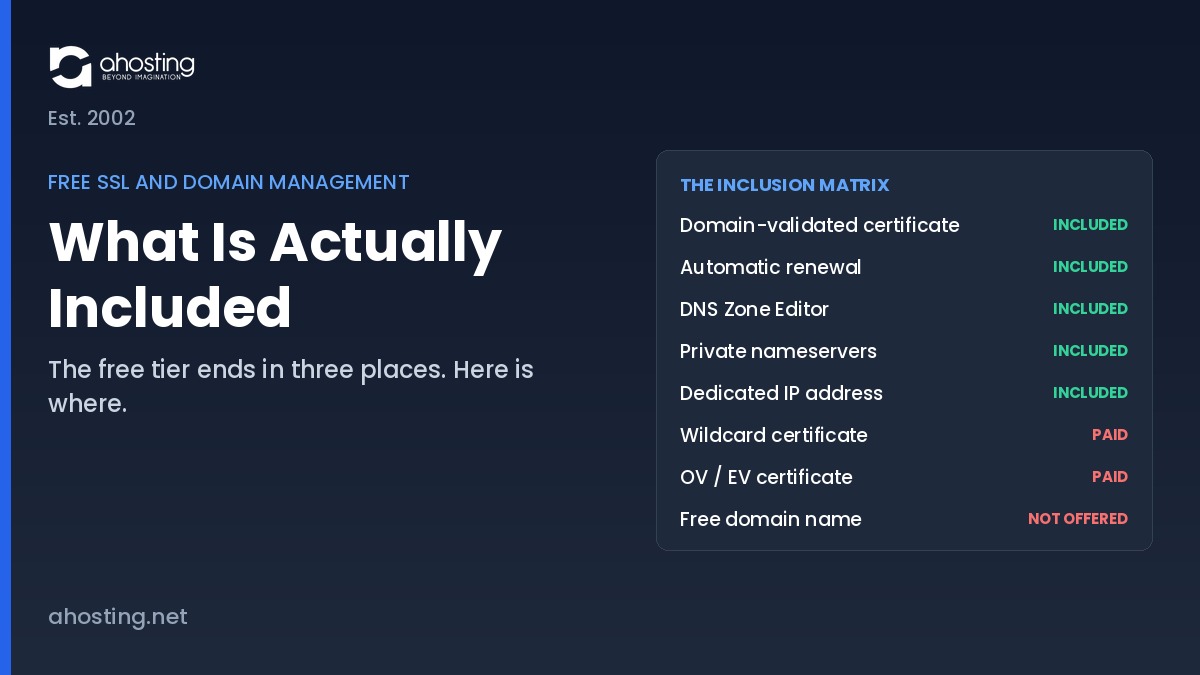
The AHosting SSL and Domain Inclusion Matrix
Below is free SSL and domain management for AHosting shared plans in full, as of August 2026. The value of the format is that it can be filled in for any provider, and the gaps tend to appear in the same three rows every time.
| Feature | Status on AHosting shared plans | Commonly upsold elsewhere |
|---|---|---|
| Domain-validated certificate | Included, all plans | Usually included |
| Automatic certificate renewal | Included, all plans | Often manual on budget tiers |
| Wildcard certificate | Paid, from $9.99 | Paid |
| Multi-domain certificate | Paid | Paid |
| OV or EV certificate | Paid | Paid |
| DNS Zone Editor | Included, all plans | Sometimes read-only |
| Private nameservers | Included, all plans | Paid or reseller tier only |
| Dedicated IP address | Included, all plans | Typically $2 to $5 per month |
| Domain registration | Paid, flat rate at renewal | Free year one, list price after |
| WHOIS privacy | Paid, $10.00 per year | Varies widely |
Check Your Own Coverage Before You Buy
Rather than reading the matrix against a hypothetical site, answer four questions about the one you actually run. The checker returns whether an included certificate covers you, and flags the nameserver problem behind most renewal failures.
SSL and Domain Coverage Checker
Four questions. The result tells you whether an included certificate covers your site, or whether you are shopping for a paid one.
A Practical Checklist for Auditing Free SSL and Domain Management Claims
Take this to any provider, including this one. Each item has a factual answer, and a vague response to any of them is itself the answer:
- Which certificate authority issues the free certificate, and is renewal automatic or manual?
- What happens when a renewal attempt fails, and who gets notified?
- Is a wildcard certificate available, and is it included or purchased?
- Can I edit my own DNS zone records, or is the zone read-only?
- Are private nameservers available, and on which plan tiers?
- If a domain is bundled, what is the renewal price in year two?
- Is WHOIS privacy included or billed separately?
- Does the plan carry a dedicated IP address, and at what cost?
Answering all eight questions about free SSL and domain management for a shortlist takes about twenty minutes and reliably separates a genuine inclusion from a marketing line. A broader version of this exercise, covering the other decision points that matter when comparing providers, sits in our small business hosting provider checklist.
Frequently Asked Questions About Free SSL and Domain Management
What does free SSL and domain management actually include on a 2026 hosting plan?
Typically, free SSL and domain management covers a domain-validated certificate that issues and renews automatically, plus a DNS zone editor and nameserver control inside cPanel. Notably, it does not cover organization-validated certificates, wildcard coverage, WHOIS privacy, or the domain registration itself. The inclusion matrix in this post separates those three categories line by line.
Free SSL vs paid SSL: what does free SSL and domain management leave out?
Specifically, a free certificate is domain-validated only. Let's Encrypt states plainly that it has no plans to issue organization-validated or extended-validation certificates, so the free tier will never carry a verified company name. Furthermore, wildcard and multi-domain coverage sit on the paid side. The difference is validation depth and coverage breadth, not encryption strength.
How long is a free SSL certificate valid in 2026, and how often does it renew?
Indeed, this is changing quickly. A Let's Encrypt certificate is valid for 90 days with a recommended renewal point at day 60, but industry rules cut the maximum lifetime to 200 days in March 2026, 100 days in March 2027, and 47 days in March 2029. As a result, renewal automation stops being a convenience and becomes the only workable method.
If my domain's DNS is hosted at my registrar, will AHosting's free SSL and domain management still renew automatically?
In practice it often will not, and this is the most common renewal failure we see. Because the renewal process writes a validation record into the DNS zone held on the hosting server, a domain whose authoritative nameservers point at the registrar sends the certificate authority to a zone that never receives that record. Consequently, validation fails quietly until someone spots the browser warning.
Wildcard SSL vs single-domain SSL: which one does a free certificate give you?
As such, the free certificate is single-domain with named subdomains added one at a time, never a true wildcard. Moreover, wildcard issuance requires the DNS-01 challenge, which means proving control through a DNS record rather than a file on the web server. For that reason a wildcard is a paid purchase even where the standard certificate costs nothing.
What is the free SSL renewal chain, and where does free SSL and domain management usually break?
Notably, the renewal chain has five links: the domain resolves, its authoritative nameservers point at the hosting account, the server writes a validation record into that zone, the certificate authority reads it, and the certificate reissues. Only the last two links belong to the certificate authority. The other three are domain management decisions, which is why these two subjects cannot be judged separately.
Does AHosting include free private nameservers with free SSL and domain management in 2026?
Indeed, every AHosting WordPress and Web hosting plan includes free private nameservers in the form ns1.yourdomain.com and ns2.yourdomain.com, alongside a free dedicated IP address and a free certificate. Additionally, the DNS Zone Editor is available on all plans, so record changes never require a support ticket.
When should a store running more than five subdomains upgrade from a free certificate to a wildcard?
Typically, the switch pays off once subdomains appear faster than anyone can add them to a certificate, which in our experience starts around five. Furthermore, staging and regional subdomains that come and go are a strong signal, because each new name needs its own validation pass. A wildcard removes that per-name step entirely.
Does AHosting give a free domain name with a hosting plan?
In contrast to much of the market, no, and the reason is deliberate. Domains are sold at a published price that is identical at registration and at renewal, so a .com costs the same in year two as in year one. A bundled free domain is normally free for twelve months and then renews at the registrar's standard rate, which is where the real cost appears.
Is there a lifetime free SSL certificate, or does every free SSL expire?
Ultimately, every publicly trusted certificate expires and no lifetime certificate exists. Specifically, the certificate authority industry has agreed a schedule that shortens the maximum lifetime to 47 days by 2029. What buyers mean by lifetime free SSL is really indefinite free renewal, which is what an automated system running on the hosting account already provides.