- Why Hosting Uptime and Support Claims Need Independent Verification
- Audit Step One: Find the Measurement Clause in the Hosting Uptime and Support Terms
- Audit Step Two: Decode the Credit Schedule and the Claim Window
- Audit Step Three: The Hosting Uptime and Support Response Test
- Audit Step Four: Stop Trusting the Status Page for Hosting Uptime and Support
- How AHosting Reads Against This Hosting Uptime and Support Audit
- The 10-Minute Hosting Uptime and Support Audit Checklist
- Frequently Asked Questions About Hosting Uptime and Support
- How do you verify hosting uptime and support claims independently in 2026?
- Uptime SLA vs uptime guarantee: what is the difference in hosting uptime and support terms?
- What percentage credit does a 95 to 99.4 percent hosting uptime and support month actually pay?
- What is the AHosting SLA credit schedule and how many days do I have to claim?
- When should I run a pre-sales hosting uptime and support response test before buying a 2026 plan?
- Support ticket vs live chat: which channel creates a usable record for an SLA claim?
- Can AHosting Tier 1 support read server error logs, or does that require escalation?
- What is the three-document problem in hosting uptime and support evaluation?
- Does AHosting publish an average support response time for 2026 shared hosting plans?
- Why do buyers check Reddit for hosting uptime and support experiences instead of provider pages?
Verify hosting uptime and support claims yourself: read the measurement clause, decode the credit schedule and claim window, then time a pre-sales technical reply. Marketing badges are not contracts.
Every provider advertises excellent hosting uptime and support. The claims are near-identical across the market, which makes them useless as a comparison signal and leaves buyers choosing on price. There is a better method, and it takes ten minutes: stop reading the marketing page and audit the documents underneath it.
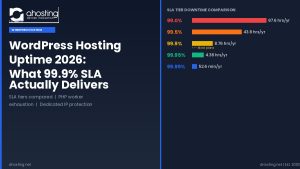
This is an audit procedure rather than a ranking, and it applies to any provider including this one. For the arithmetic on what a given percentage costs in minutes per year, see our breakdown of what a 99.9% uptime SLA actually delivers. This guide covers whether that number is worth anything at all.
Why Hosting Uptime and Support Claims Need Independent Verification
Advertised availability and advertised responsiveness are objective claims, not opinions, which means they are supposed to rest on evidence the advertiser already holds. The verification problem is not that providers lie. It is that the badge, the contract and the remedy live in three separate documents, and almost nobody reads past the first one.
The Three-Document Problem
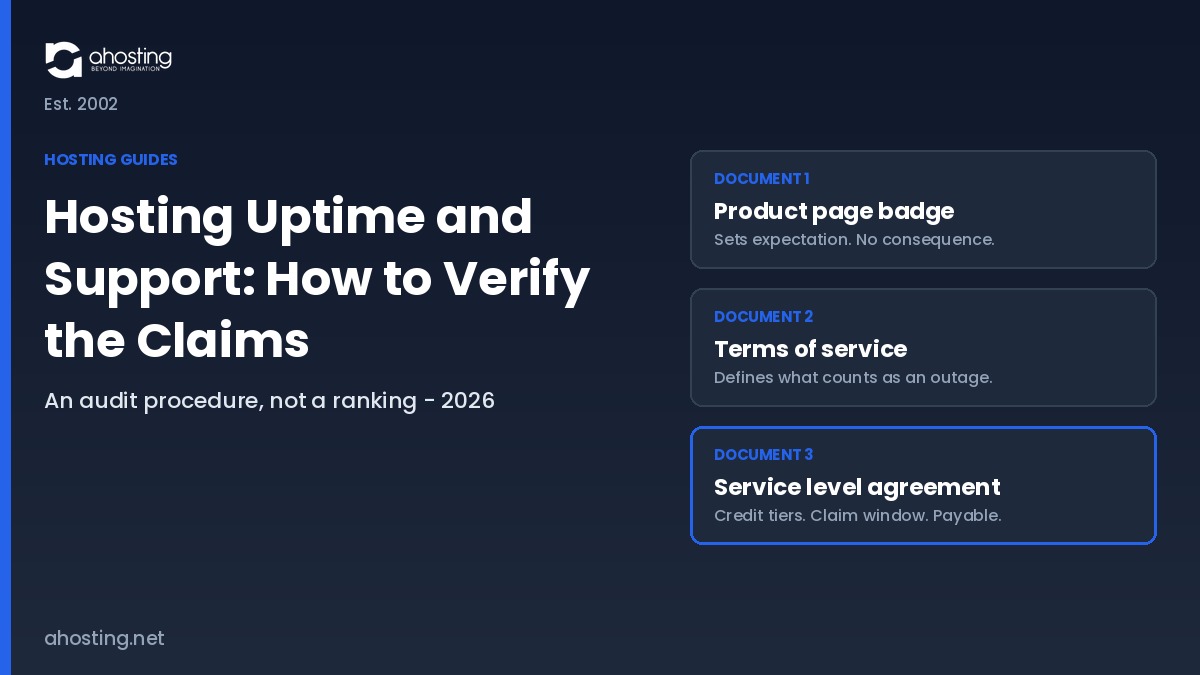
Availability commitments are split across a product page, a terms of service clause and a service level agreement. Notably, each layer carries a different trigger, a different deadline and a different channel for making a claim. The badge sets an expectation, the terms of service defines what counts as an outage, and the service level agreement decides what you actually receive when one happens.
That split is why two providers advertising identical hosting uptime and support figures can offer wildly different protection. One measures a single reachability probe from its own network; another measures application response from several regions. Furthermore, one pays automatically while the other requires a written claim inside a window most customers miss.
What a Product Page Badge Legally Commits a Host To
On its own, very little. A badge is an expectation, and the enforceable version of it lives further down the stack. The distinction is standard engineering vocabulary rather than legal hairsplitting: Google’s site reliability engineering handbook frames an objective as a target and an agreement as a target with a defined consequence attached. Ask what happens when the number is missed, and if the honest answer is nothing, you were reading a target.
That said, the badge is not meaningless. Under the FTC policy statement on advertising substantiation, an advertiser making an objective claim is expected to hold a reasonable basis for it before publishing. So the badge is a legitimate thing to ask questions about. It is simply the beginning of the audit rather than the end of it.
Audit Step One: Find the Measurement Clause in the Hosting Uptime and Support Terms
Open the service level agreement and find the sentence that defines what is being measured and by whom. In practice this single clause determines more than the headline percentage does, because it decides which of your outages are even eligible to be counted.
Who Holds the Stopwatch
Most agreements state that availability is determined by the provider’s own monitoring agents rather than any individual customer’s experience. That wording is defensible, since a customer’s ISP or a routing fault can make a healthy server look unreachable. It also means your own monitor is evidence rather than proof.
Accordingly, ask in writing where the monitoring agents sit, how often they probe, and how many consecutive failures constitute an outage. A precise answer tells you the measurement is real. Silence is also an answer.
What Counts as Down, and What Quietly Does Not
Most hosting agreements measure network connectivity for HTTP access. Therefore a request that completes is a success by that definition, regardless of what the page contains. The HTTP semantics specification, RFC 9110 is explicit that a successful status code reports on the request, not on whether your application produced anything a customer would recognize as working.
The practical gap is large. A WordPress site returning a database connection error, a blank page, or a checkout that times out after thirty seconds may still be answering requests. Similarly, PHP worker exhaustion under load produces the queued 503 responses covered in our PHP worker guide that never appear as downtime in a connectivity-based measurement. Grade the definition, not the number in front of it.
Then read the exclusion list, which is where most claims quietly die. Standard exclusions cover scheduled maintenance, customer-side configuration, third-party software, and events outside the provider’s control including DNS propagation and upstream network faults. Consequently the honest way to read a schedule is to assume anything you caused, anything announced in advance, and anything upstream is uncounted.
Audit Step Two: Decode the Credit Schedule and the Claim Window
A credit schedule converts a missed target into money. Six clauses decide whether that conversion is realistic or theatrical, and every one of them has a published answer somewhere in a reputable provider’s documents. Below is the table to run any provider through.
| # | Clause to extract | Where it lives | The disqualifying answer |
|---|---|---|---|
| 1 | Measurement basis | SLA, service level section | No definition of what is measured |
| 2 | Who monitors | SLA, limitations section | Unstated, or “at our discretion” |
| 3 | Credit tiers and percentages | SLA, credits section | Credit amount decided case by case |
| 4 | Claim window and channel | SLA or terms of service | No deadline published anywhere |
| 5 | Exclusion list | SLA, restrictions section | Open-ended “including but not limited to” with no examples |
| 6 | Measured support response time | Product page or support policy | Availability hours with no number attached |
Why the Claim Window Costs Buyers More Than the Percentage Does
Credit percentages cluster in a narrow range across the industry, so they rarely separate providers. Deadlines do. A window measured in business days runs from the outage itself, not from the moment you notice it, so a Friday evening incident found the following Tuesday has already burned much of the time available.
For example, AHosting publishes a three-tier schedule paying 10 percent of the affected month between 95 and 99.4 percent, 25 percent between 90 and 94.9 percent, and 50 percent at or below 89.9 percent, with claims filed by support ticket inside seven business days and credits applied within sixty days. Those figures appear in the published service level agreement, which is exactly where they should be findable without a phone call.
The Second Availability Clock Most Buyers Never Find
One further trap catches buyers of higher-tier products. A provider can run more than one availability clock, each with its own deadline and its own submission channel, and hosting uptime and support terms rarely cross-reference them.
| Dimension | Network availability clock | Hardware replacement clock |
|---|---|---|
| What it covers | HTTP reachability across the network | Physical component failure on a dedicated machine |
| Commitment | 99.9% network uptime per calendar month | Replacement within 1 to 8 hours of confirmation |
| Credit curve | Three tiers: 10%, 25%, 50% | 5% per additional 8-hour block, up to 100% |
| Claim window | Seven business days | Ten days |
| Where to file | Support ticket | Email to the sales address |
| Review hours | Standard ticket handling | Monday to Friday, 9am to 5pm EST |
Both clocks are published, one in the service level agreement and one in the terms of service. Ultimately the lesson generalizes to every provider you evaluate: if you buy a dedicated server, confirm which clock covers your failure mode before you need it, because filing against the wrong one wastes the window.
Audit Step Three: The Hosting Uptime and Support Response Test
Support is the half of the equation with no contract behind it at almost every provider, which makes it the half you must test yourself. Fortunately the protocol is cheap and runs before you spend anything.
The Pre-Sales Timing Test
Open a pre-sales conversation with a specific technical question rather than a pricing question, because pricing routes to sales and tells you nothing about the technical queue. Time the first substantive reply, not the automated acknowledgement.
- Ask something concrete: which PHP versions are selectable, what the container memory ceiling is, whether staging pushes to production.
- Run the test twice, once inside business hours and once after midnight in the provider’s stated timezone.
- Record the gap between your message and the first human answer that contains information.
- Compare that gap against whatever response figure the provider advertises.
Notably, a provider that publishes a measured figure has already accepted the comparison. AHosting states an average first response of two to five minutes across every hosting package, which is a number you can hold it to. Providers advertising only coverage hours have published nothing testable, and that distinction is worth more than any review score.
The Tier 1 Diagnostic Question
One question separates support organizations: can the first person who answers read your server error logs? A tier that reads logs resolves incidents. A tier that cannot merely records them and forwards a ticket into a queue, turning a fifteen-minute problem into an overnight one.
Service management practice treats this as a design decision rather than an accident. The international service management standard ISO/IEC 20000-1 requires providers to define service levels with measurable targets and to report against them, which is precisely the discipline missing wherever a support tier exists only to triage. Ask the question during the pre-sales test and note the answer verbatim.
Understand the capability ladder before asking. First-touch technicians who read error logs, inspect resource faults and restart a PHP handler cover most real incidents. Work needing kernel-level access belongs on a VPS plan where you hold root, and that boundary should be stated rather than discovered.
Which Channel Creates a Record You Can Cite Later
Chat and tickets serve different purposes and only one of them produces evidence. A ticket carries a timestamp, a persistent thread and a reference number you can quote inside a credit claim. Chat transcripts are frequently not retained in any form the customer controls, so a chat-only exchange about a billable outage leaves you arguing from memory.
In practice the workflow that survives a real incident is simple: use chat for triage, and open a ticket the moment an outage looks like it might cross a credit threshold. Where chat runs through a support portal, ask whether the transcript attaches to your account afterward.
Agencies carry this problem multiplied by their client count, so standardize on ticket-first reporting across every managed site. Reconstructing outage timelines for twenty clients out of chat history is not a recoverable position.
Audit Step Four: Stop Trusting the Status Page for Hosting Uptime and Support
A status page reports what the provider measured. It is a useful signal and a poor sole source, because the basis is the provider’s own and the exclusion list has already been applied before anything is published.
Therefore run your own probe. A free external monitor such as UptimeRobot checking every five minutes from outside your network gives you an independent timeline, and the setup takes under ten minutes. Point it at a URL that exercises the database rather than a static file, so an application-layer failure registers instead of hiding behind a cached page.
How AHosting Reads Against This Hosting Uptime and Support Audit
Running a provider through its own checklist is the only honest way to publish one. AHosting commits to 99.9 percent network uptime per calendar month in its terms of service, publishes a tiered credit schedule with a seven business day claim window, and states an average first response of two to five minutes across every package.
Additionally, first-touch technicians read server error logs directly rather than escalating for a diagnostic read, and the claim channel is a support ticket that produces the timestamped record a credit request needs. Those are the six clauses from the audit table, answered in public. Every WordPress hosting plan carries the same commitments regardless of tier.
Score any provider below, including this one. The scorer is deliberately unforgiving on the clauses that decide whether a hosting uptime and support guarantee is collectible rather than decorative.
SLA Collectibility Scorer
Answer six questions from the provider’s own published documents. No answer found counts as a no.
The 10-Minute Hosting Uptime and Support Audit Checklist
Work the list in order. Every hosting uptime and support item below resolves to a written answer, and a provider that cannot supply one has told you something useful.
- Locate the service level agreement from the footer, not from a search engine result.
- Read the measurement clause and write down what is measured and by whom.
- Copy the credit tiers into a note, including the lowest qualifying band.
- Find the claim deadline and the filing channel, then set a calendar reminder template for it.
- Scan the exclusion list for open-ended language with no examples.
- Check whether a second availability clock exists for your product tier.
- Send a pre-sales technical question and time the first substantive reply.
- Repeat the timing test outside business hours in the provider's timezone.
- Ask directly whether first-touch support reads server error logs.
- Point an external monitor at a database-backed URL before you migrate anything.
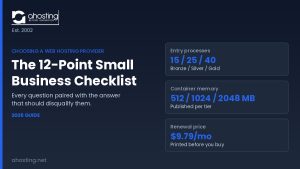
Run this before you buy and you will never again choose a host on a badge. If the audit fails on a provider you are already using, our guide to migrating WordPress to a new host covers the mechanics of leaving without an outage of your own making. The wider evaluation framework sits in our 12-point checklist for choosing a web hosting provider.
Frequently Asked Questions About Hosting Uptime and Support
How do you verify hosting uptime and support claims independently in 2026?
Specifically, you read three documents in order: the product page badge, the terms of service clause that defines the commitment, and the service level agreement that sets the credit schedule. Each one says something different, and only the third one is enforceable. The audit checklist near the end of this guide walks the sequence in about ten minutes.
Uptime SLA vs uptime guarantee: what is the difference in hosting uptime and support terms?
In practice, a guarantee is a marketing target with no stated consequence, while a service level agreement names a measurement method, a credit schedule and a claim deadline. Google's site reliability engineering team draws the same line: if missing the number carries no defined consequence, you are looking at an objective rather than an agreement.
What percentage credit does a 95 to 99.4 percent hosting uptime and support month actually pay?
Typically, that band pays the smallest tier on a published schedule. On AHosting's schedule it returns 10 percent of that month's service charge, rising to 25 percent between 90 and 94.9 percent, and 50 percent at or below 89.9 percent. The audit table in this guide shows why the percentage matters far less than the deadline attached to it.
What is the AHosting SLA credit schedule and how many days do I have to claim?
Notably, AHosting publishes a three-tier credit schedule paying 10, 25 or 50 percent of the affected month's service charge, and the claim must be filed by support ticket within seven business days of the outage. Credits are typically applied within sixty days, and the credit is the sole remedy.
When should I run a pre-sales hosting uptime and support response test before buying a 2026 plan?
Ultimately, run it twice before you pay: once during business hours and once after midnight in the provider's stated timezone. Send a specific technical question rather than a pricing question, because the second one routes to sales. Compare the two response times against whatever number the provider advertises.
Support ticket vs live chat: which channel creates a usable record for an SLA claim?
Indeed, the ticket wins on every SLA claim. A ticket carries a timestamp, a persistent thread and an identifier you can quote in a credit request, whereas most chat transcripts are not retained in a form the customer controls. Use chat for triage and open a ticket the moment an outage looks billable.
Can AHosting Tier 1 support read server error logs, or does that require escalation?
Fortunately, AHosting's first-touch technicians read server error logs directly rather than routing the request upward. That single capability is what separates a support tier that resolves an incident from one that merely records it, and it is worth asking every provider before you buy.
What is the three-document problem in hosting uptime and support evaluation?
Furthermore, this guide names the pattern the audit is built to defeat: availability commitments are split across a product page, a terms of service clause and a service level agreement, each with a different trigger, deadline and channel. Buyers read only the first document, then discover the other two after an outage.
Does AHosting publish an average support response time for 2026 shared hosting plans?
Moreover, AHosting publishes an average first-response time of two to five minutes across all hosting packages, alongside round-the-clock coverage. A published figure is itself the signal worth grading, because most providers advertise availability hours without ever attaching a measured number to them.
Why do buyers check Reddit for hosting uptime and support experiences instead of provider pages?
Interestingly, they are compensating for a disclosure gap rather than distrusting the provider. Peer reports fill in what the marketing page omits, which is the measurement basis, the exclusion list and the claim window. Reading the contract yourself gets you the same answers faster, and this guide's scorer grades any provider on six clauses.