
- Why Choosing a Web Hosting Provider Is a Disclosure Problem, Not a Ranking Problem
- The 12-Point Checklist for Choosing a Web Hosting Provider
- First Group — Resource Transparency (Questions 1 to 3)
- Second Group — Uptime Measurement and Remedy (Questions 4 to 6)
- Third Group — Isolation and Reputation (Questions 7 and 8)
- Fourth Group — Support, Backups, and Recovery (Questions 9 and 10)
- Fifth Group — Renewal, Migration, and Exit (Questions 11 and 12)
- The Spec Disclosure Test: What a Host Publishes Versus What It Withholds
- Choosing a Web Hosting Provider by Business Type: What Actually Changes
- The SSL Question Changed in 2026
- Renewal Pricing and Exit Terms: The Two Numbers Most Checklists Skip
- Score Your Shortlist
- How AHosting Answers All Twelve Questions
- A Practical Checklist Before You Decide
- Frequently Asked Questions About Choosing a Web Hosting Provider
- What should I look for when choosing a web hosting provider for a small business in 2026?
- Shared hosting vs VPS when choosing a web hosting provider: which does a small business actually need?
- Is a cheap web hosting plan in 2026 a false economy once renewal pricing is included?
- What does a web hosting uptime SLA actually measure, and what happens when a provider misses it?
- How do I verify a web hosting provider's account isolation, and what does AHosting actually use?
- Why does the shift to 45-day SSL certificates change what to ask a hosting provider in 2026?
- What backup policy details should a small business demand before choosing a web hosting provider?
- How many PHP workers does a small business site need on AHosting's shared hosting tiers?
- Free migration vs paid migration: what should a small business confirm before switching hosts?
- Does choosing a web hosting provider with a free dedicated IP, as AHosting includes, change anything for a small business?
Choosing a web hosting provider comes down to twelve questions with published numbers behind them. A host that will not disclose worker counts, memory ceilings, or renewal pricing is telling you something.
Choosing a web hosting provider is usually presented as a ranking problem, and that framing is why so many small businesses end up on the wrong plan. Specifically, the advice available online almost always arrives as a list of providers rather than a method for interrogating one. Consequently, buyers compare marketing pages against marketing pages, and the decision turns on which company writes the most confident copy rather than which one publishes the numbers that govern whether a site stays up.
This guide inverts that. Instead of naming providers, it treats choosing a web hosting provider as an interrogation: twelve questions to put to any host, and — more usefully — the answer to each one that should disqualify them. Notably, every question below has a checkable answer, which is precisely why some providers avoid answering it.
Why Choosing a Web Hosting Provider Is a Disclosure Problem, Not a Ranking Problem
The single most predictive signal in hosting is what a provider will put in writing. Specifically, four numbers govern whether a shared hosting account performs under real load: concurrent PHP workers, the per-account memory ceiling, CPU allocation, and disk IO throughput. Furthermore, all four are configured values that every provider knows exactly, which means an unwillingness to publish them is a choice rather than an oversight.
Those limits are not marketing abstractions. In practice, they are enforced at the kernel by CloudLinux LVE, which caps CPU, physical and virtual memory, IO, process count, and entry processes per account — and returns an error once the entry process ceiling is reached. Therefore, “unlimited” is never a description of the underlying configuration. Indeed, it is a description of the billing policy.
Ultimately, this is what separates a useful hosting evaluation from a comparison of adjectives. Every question in the checklist below is written so that a vague answer is itself the finding.
The 12-Point Checklist for Choosing a Web Hosting Provider
Below, each checkpoint is written as a question to ask the host, paired with the reply that should end the conversation. Notably, you can run the whole list through a pre-sales chat window in about ten minutes, and the pattern of evasion tends to appear well before question twelve.
First Group — Resource Transparency (Questions 1 to 3)
Specifically, this group establishes whether the provider will quantify what you are renting. In practice, a host that answers all three has almost certainly sized its plans deliberately; a host that answers none is selling density.
Notably, question two catches a common substitution. Many providers quote the PHP memory_limit value, which governs one request, while staying quiet about the container ceiling that governs the whole account. Consequently, a site can be configured for 512 MB per request inside an account capped well below that in aggregate — and the failure surfaces as an intermittent white screen rather than a clear error.
Second Group — Uptime Measurement and Remedy (Questions 4 to 6)
Generally, uptime guarantees are the most quoted and least examined line in hosting, and they are where choosing a web hosting provider most often goes wrong. In particular, almost every provider advertises 99.9%, which means the figure carries no comparative information at all. Therefore, the useful questions are what the number measures, how it is measured, and what happens when it is missed.
Most SLAs, including ours, measure network reachability rather than whether your application returned a usable page. Accordingly, the honest reading is that application-level availability remains your responsibility — which is exactly why worker exhaustion can take a site down without ever breaching an SLA. Our guide to what a 99.9% uptime SLA actually delivers works through the arithmetic in detail.
Third Group — Isolation and Reputation (Questions 7 and 8)
On shared infrastructure, your neighbors are part of your threat model. Specifically, the FTC’s Start with Security guidance for businesses makes segmentation and sensible access control two of its core lessons, and the same principle applies one layer down: a firewall guards the perimeter, not the accounts inside it.
Furthermore, reputation is shared by default. In contrast to a dedicated address, a shared IP means another account’s spam or malware incident becomes your email deliverability problem. Our breakdown of server-level protection that plugins cannot add covers what isolation actually prevents.
Fourth Group — Support, Backups, and Recovery (Questions 9 and 10)
Backups are where vague answers cost the most. Specifically, NIST SP 800-34 Rev. 1 states that a backup policy should designate the frequency of backups, the location of stored data, media rotation frequency, and the method for transporting data offsite. Therefore, a provider that describes backups as a courtesy rather than a policy has answered the question — just not the way it intended.
Similarly, “24/7 support” is a staffing claim rather than a performance claim. Accordingly, ask for a measured first-response figure and confirm it applies to your plan tier rather than only to the premium one.
Fifth Group — Renewal, Migration, and Exit (Questions 11 and 12)
Finally, the commercial terms — the part of choosing a web hosting provider that surfaces twelve months after the decision. Notably, introductory pricing governs only the first term, and renewal increases of three to nine times the entry rate are common enough across the market to be the default assumption rather than the exception. Consequently, the number worth writing down is the year-two price.
Migration deserves the same scrutiny. In particular, confirm who performs the transfer, whether a fee appears after purchase, and how an unusually large site is handled — because a fee disclosed at checkout is a reasonable predictor of how later surprises will be handled.
| # | Ask the host | The answer that should disqualify them |
|---|---|---|
| 1 | How many concurrent PHP workers (entry processes) does this plan get? | “Unlimited,” or “we don’t publish that” |
| 2 | What is the per-account memory ceiling, and is that PHP memory_limit or the container cap? | Quoting only memory_limit and changing the subject |
| 3 | What CPU percentage and disk IO throughput are allocated to this plan? | “Our servers are fast” with no figure |
| 4 | What does your uptime SLA measure — network, or application response? | Refusing to state which |
| 5 | Is there a published credit schedule when you miss it? | No published schedule of any kind |
| 6 | Who measures uptime, and can I see the method? | “Third-party verified” with no source named |
| 7 | What kernel-level technology isolates my account from its neighbors? | Naming a firewall as the isolation layer |
| 8 | Do I get a dedicated IP, or do I share sending reputation? | “IP reputation doesn’t matter anymore” |
| 9 | What does your backup policy specify — frequency, location, offsite method? | “Backups are provided as a courtesy” |
| 10 | What is your measured first-response time, and does it apply to my tier? | “24/7 support” with no number attached |
| 11 | What is the renewal price, in writing, before I buy? | Renewal pricing not published anywhere |
| 12 | Who performs migration, at what cost, and what if my site is unusually large? | A migration fee that appears only at checkout |
The Spec Disclosure Test: What a Host Publishes Versus What It Withholds
Rather than compare providers on features, compare them on disclosure. Specifically, the table below lists the six figures that determine real-world behavior on a shared plan, alongside how commonly each is published across the market and what AHosting states.
| Figure | What it governs | Commonly published? | AHosting (Bronze / Silver / Gold) |
|---|---|---|---|
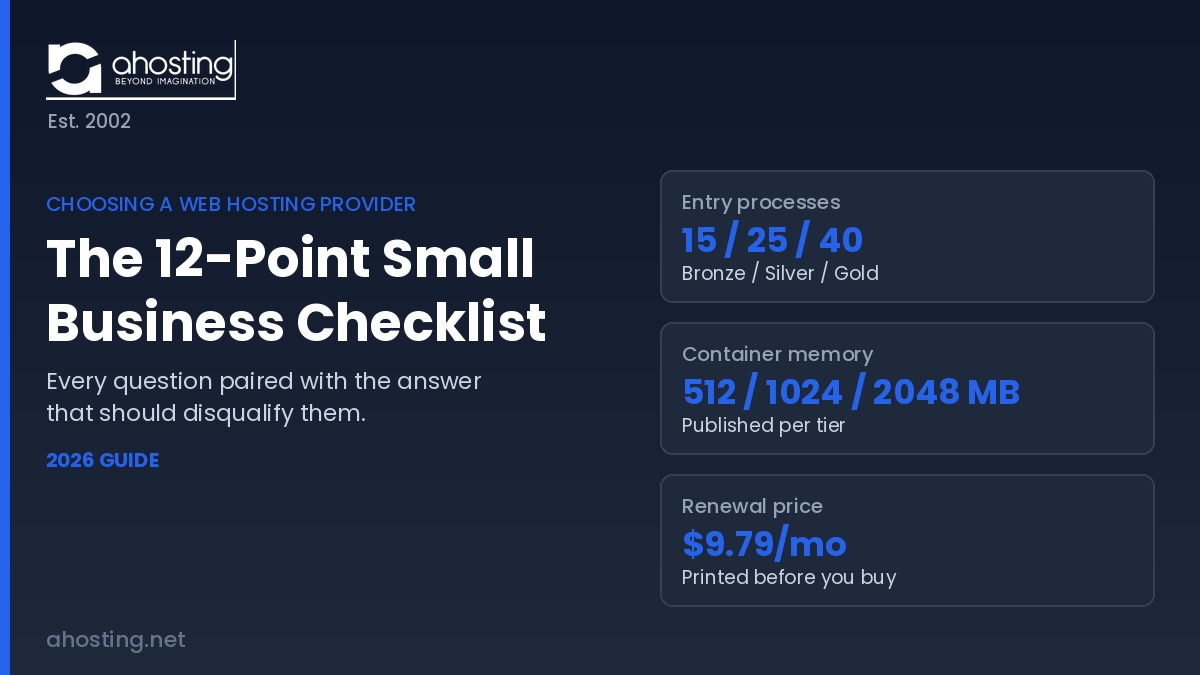
| Entry processes | Concurrent dynamic requests | Rarely | 15 / 25 / 40 |
| Container memory (PMEM) | Per-account RAM ceiling | Rarely | 512 / 1024 / 2048 MB |
| CPU allocation | Share of processor time | Rarely | 100% / 200% / 400% |
| Disk IO throughput | Read and write speed | Rarely | 5120 / 10240 / 20480 KB/s |
| Measured TTFB | Real server response time | Rarely | ~16 ms cached; 700-1,400 ms uncached |
| Renewal price | Year-two cost | Sometimes | $9.79/mo (from $2.79/mo intro) |
Notably, the point of this table is not the values themselves. Rather, it is that they exist in a published form at all — which is the property you are testing for when choosing a web hosting provider. Our side-by-side hosting comparison applies the same disclosure standard across eight providers.
Choosing a Web Hosting Provider by Business Type: What Actually Changes
Site shape matters more than traffic volume. Specifically, the deciding variable is what proportion of your requests can be served from cache, because cached pages consume no PHP workers at all. Consequently, two sites with identical visitor counts can sit two plan tiers apart.
Before sizing anything, define the business model the site serves — the SBA’s guidance on market research and competitive analysis is the standard starting point. Afterward, the specification follows from the model rather than from a guess.
| Site type | Uncacheable share | What actually changes in the spec | Typical shape |
|---|---|---|---|
| Brochure site (5-15 pages) | Very low | Almost nothing — server-level cache carries it | Entry tier is genuinely sufficient |
| Lead-generation site | Low, but bursty | Form posts bypass cache; email deliverability becomes critical | Entry tier plus a dedicated IP |
| Small online store | High per session | Cart and checkout never cache; object caching and worker headroom decide it | Mid tier or store-specific plan |
| High-traffic content site | Low but high volume | Cache hit ratio and IO throughput dominate; bursts need headroom | Top shared tier, then VPS |
For a straightforward business site, our web hosting plans cover the first two rows comfortably. Meanwhile, stores benefit from the cache-exclusion rules and worker allocation that ship pre-configured on WooCommerce hosting, and high-traffic content sites eventually move to VPS hosting for guaranteed resources. For a full breakdown of the arithmetic, see our guide to how many concurrent users shared hosting handles.
The SSL Question Changed in 2026
Free SSL stopped being a differentiator years ago. However, the question underneath it just became sharper: Let’s Encrypt is reducing default certificate lifetimes to 64 days in February 2027 and 45 days in February 2028, with the authorization reuse window falling to seven hours.
Consequently, manual renewal stops being viable, and a certificate nobody renews automatically becomes a scheduled outage. Therefore, the useful question is no longer whether SSL is included but whether renewal is automated through ACME and what the provider does when a renewal fails. Notably, this is one checkpoint where a host running its own automation has a structural advantage over one that hands you a certificate and wishes you luck.
Renewal Pricing and Exit Terms: The Two Numbers Most Checklists Skip
Renewal pricing is the most reliably underexamined term in hosting. Specifically, a plan advertised at a low introductory rate may renew at several times that figure, and the increase typically lands at the moment switching is most inconvenient. Therefore, treat the year-two price as the real price.
Exit terms deserve equal weight. In particular, ask what happens on the way out: whether you can export a full account backup yourself, whether a refund window exists, and whether migration assistance is offered in both directions. Fortunately, these are all answerable before purchase. AHosting publishes a $9.79 monthly renewal rate, a 30-day money-back guarantee, and free cPanel-to-cPanel migration with no published per-site limit — with unusually large or multi-subdomain sites scoped with the customer before the transfer runs. Our walkthrough of migrating to a new host without downtime covers the mechanics.
Score Your Shortlist
Run each candidate through the twelve checkpoints and score the result, so that choosing a web hosting provider becomes arithmetic rather than impression. Specifically, tick only the boxes where you received a specific, published answer rather than a reassurance.
Host Qualification Scorecard
Check each box only where you received a specific published answer.
How AHosting Answers All Twelve Questions
Applying our own checklist to ourselves is the only honest way to publish a guide on choosing a web hosting provider. Specifically, entry processes, container memory, CPU, and IO are published per tier in the disclosure table above. Furthermore, every shared plan runs CloudLinux CageFS and LVE for kernel-level isolation, includes a free dedicated IP, and carries daily offsite backups.
On support, our measured first response averages two to five minutes across all packages rather than only the premium tiers. Meanwhile, the SLA publishes a tiered credit schedule of 10, 25, and 50 percent, and renewal pricing appears on the product page before purchase rather than after it. For businesses that outgrow shared capacity entirely, dedicated servers remove the shared-resource variable altogether.
Indeed, the one checkpoint worth flagging honestly is the SLA scope: like most providers, ours measures network connectivity for HTTP access rather than application response. Consequently, we publish worker counts precisely so that the application-layer half remains something you can plan for rather than discover.
A Practical Checklist Before You Decide
- Collected published worker, memory, CPU, and IO figures for every shortlisted plan
- Confirmed the year-two renewal price in writing
- Identified which kernel technology isolates accounts
- Confirmed a dedicated IP is available and priced
- Obtained a backup policy stating frequency and offsite method
- Asked for a measured support response figure that applies to your tier
- Confirmed migration cost, ownership, and large-site handling
- Matched the plan to your uncacheable request share, not your visitor count
- Checked that SSL renewal is automated ahead of the 2027 and 2028 lifetime changes
- Scored each provider out of twelve and kept the notes
Ultimately, choosing a web hosting provider well is less about finding the best host than about eliminating the ones that will not tell you what you are buying. Notably, that filter removes most of the market before price ever enters the conversation. If your current provider fails more than four checkpoints, our guide to telling whether your server or your plugins are the problem is the fastest way to confirm it with data.
Frequently Asked Questions About Choosing a Web Hosting Provider
What should I look for when choosing a web hosting provider for a small business in 2026?
Specifically, ask for four numbers a host can either publish or cannot: concurrent PHP workers, the per-account memory ceiling, CPU allocation, and disk IO throughput. Furthermore, a provider that answers all four in writing is measurably easier to size a plan against than one that answers none. Therefore, treat an unwillingness to publish as the finding itself. The full 12-point table above pairs every question with the answer that should end the conversation.
Shared hosting vs VPS when choosing a web hosting provider: which does a small business actually need?
Typically, the deciding factor is not traffic volume but how much of your traffic is uncacheable. In practice, a brochure site serves almost everything from cache and rarely needs a VPS, while a store whose cart and checkout bypass cache on every session runs into the worker ceiling far earlier. Consequently, the business-type table in this guide maps four common site shapes to what actually changes in the specification.
Is a cheap web hosting plan in 2026 a false economy once renewal pricing is included?
Frequently, yes. Notably, the introductory rate governs only the first term, and several major providers renew between three and nine times their advertised entry price. Therefore, the number that matters is the year-two price, published in writing before purchase. Notably, a provider that prints its renewal rate on the product page has already cleared checkpoint eleven.
What does a web hosting uptime SLA actually measure, and what happens when a provider misses it?
Generally, an uptime SLA measures network reachability rather than whether your application returned a usable page. Additionally, the meaningful question is whether a published credit schedule exists at all. Consequently, a guarantee with no stated remedy is a marketing line rather than a commitment. Our uptime guide breaks down what the remaining downtime allowance costs an average small business per year.
How do I verify a web hosting provider's account isolation, and what does AHosting actually use?
Specifically, ask which kernel-level technology separates accounts, because a firewall protects the perimeter rather than the neighbors inside it. In contrast, CloudLinux CageFS and LVE isolate each account's filesystem and resource pool at the kernel, and AHosting runs both on every shared plan. Therefore, treat a firewall-only answer from any provider as a failed checkpoint.
Why does the shift to 45-day SSL certificates change what to ask a hosting provider in 2026?
Notably, Let's Encrypt is reducing default certificate lifetimes to 64 days in February 2027 and 45 days in February 2028. Consequently, free SSL is no longer the useful question, because a certificate nobody renews automatically becomes an outage on a schedule. Instead, ask whether renewal is automated through ACME and what happens when it fails.
What backup policy details should a small business demand before choosing a web hosting provider?
Specifically, NIST SP 800-34 states that a backup policy should designate frequency, the location of stored data, media rotation, and the method for transporting data offsite. Therefore, the disqualifying answer is a provider that treats backups as a courtesy rather than a stated policy. Consequently, ask for the policy itself rather than the reassurance.
How many PHP workers does a small business site need on AHosting's shared hosting tiers?
Typically, a brochure or lead-generation site running server-level caching needs far fewer workers than owners assume, because cached pages consume none at all. However, uncacheable requests such as form posts, logged-in sessions, and checkout are what actually draw against the ceiling. AHosting publishes 15, 25, and 40 entry processes across Bronze, Silver, and Gold, and our concurrency guide works the arithmetic against those tiers.
Free migration vs paid migration: what should a small business confirm before switching hosts?
Specifically, confirm who performs the transfer, whether a fee appears after purchase, and how an unusually large site is handled. Indeed, migration fees disclosed only at checkout are a reliable signal of how the rest of the relationship will run. AHosting performs cPanel-to-cPanel migrations at no charge with no published per-site limit, and scopes outsized sites with the customer in advance.
Does choosing a web hosting provider with a free dedicated IP, as AHosting includes, change anything for a small business?
Fortunately, the answer is now easier to reason about than the old ranking debate suggested. In particular, a dedicated IP protects transactional email deliverability and separates your reputation from every other account on the machine. AHosting includes one free on every plan, which is unusual enough that most comparison tables treat it as a differentiator rather than a given.