
-

You Should Use a Persistent Object Cache: What WordPress Site Health Actually Measures
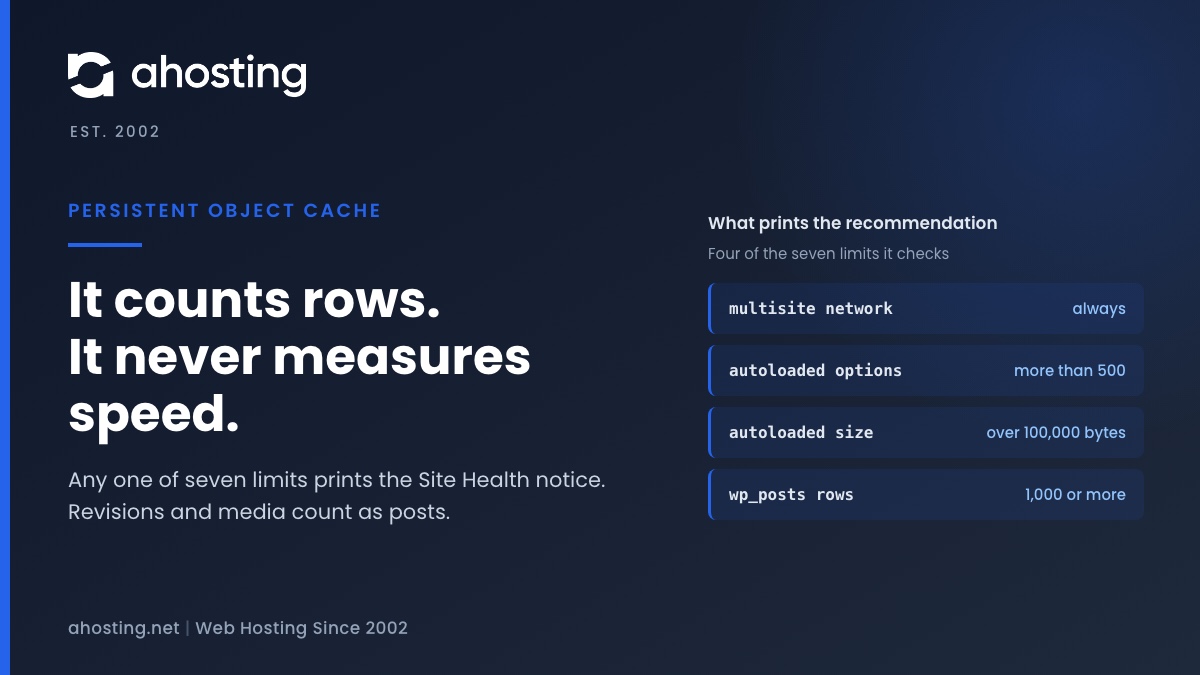
TL;DRSite Health recommends a persistent object cache when your site crosses a size line, not when it is slow. Any one of seven counters is enough: a multisite network, more than 500 autoloaded options or 100,000 bytes of them, or 1,000 rows in the posts, comments, options, terms or users table. Revisions and media count as posts, so small sites trip it often. An object cache also needs a cache server, and a plugin alone cannot provide one. Decide first whether your traffic is the kind an object cache speeds up.
Categories
- CMS
- Concrete5
- Drupal
- FFmpeg / Video Hosting
- Hosting Guides
- How To
- Joomla
- Security
- SEO
- Uncategorized
- Video Content
- Web Hosting News
- WooCommerce
- WordPress
Lets Connect!
-
WordPress Is About To Get A Lot Better At eCommerce
WordPress parent company Automattic is finally spending the $160 million in funding it raised last year – on plugins, apparently. Late last month, it purchased WooCommerce, a powerful shopping plugin designed to help publishers turn their websites into digital…

-
What Are The Most Important Factors In The Creation Of Compelling Video?
So, you want to create a few videos for your brand? That’s awesome. With the runaway success of YouTube, video content is now bigger than ever – and few things are more memorable than an awesome video ad. There’s…

-
Why It’s Now More Important Than Ever To See To Security On Your WordPress Blog
According to a report from CodeGuard, WordPress now powers 79% of content-driven websites. By comparison, Joomla powers 7.2%, and Drupal 5.3%. The report further notes that designers and developers are flocking to the platform in droves; it’s gained more…

-
CMS-Targeted Attacks Are Only Going To Get More Frequent: Here’s How To Protect Yourself
Recently, Finnish security researcher Joukou Pynnonen revealed a security flaw in Yoast’s WordPress SEO plugin which allowed hackers to take over the administrator account of any CMS on which the plugin was installed. One of the most popular SEO…